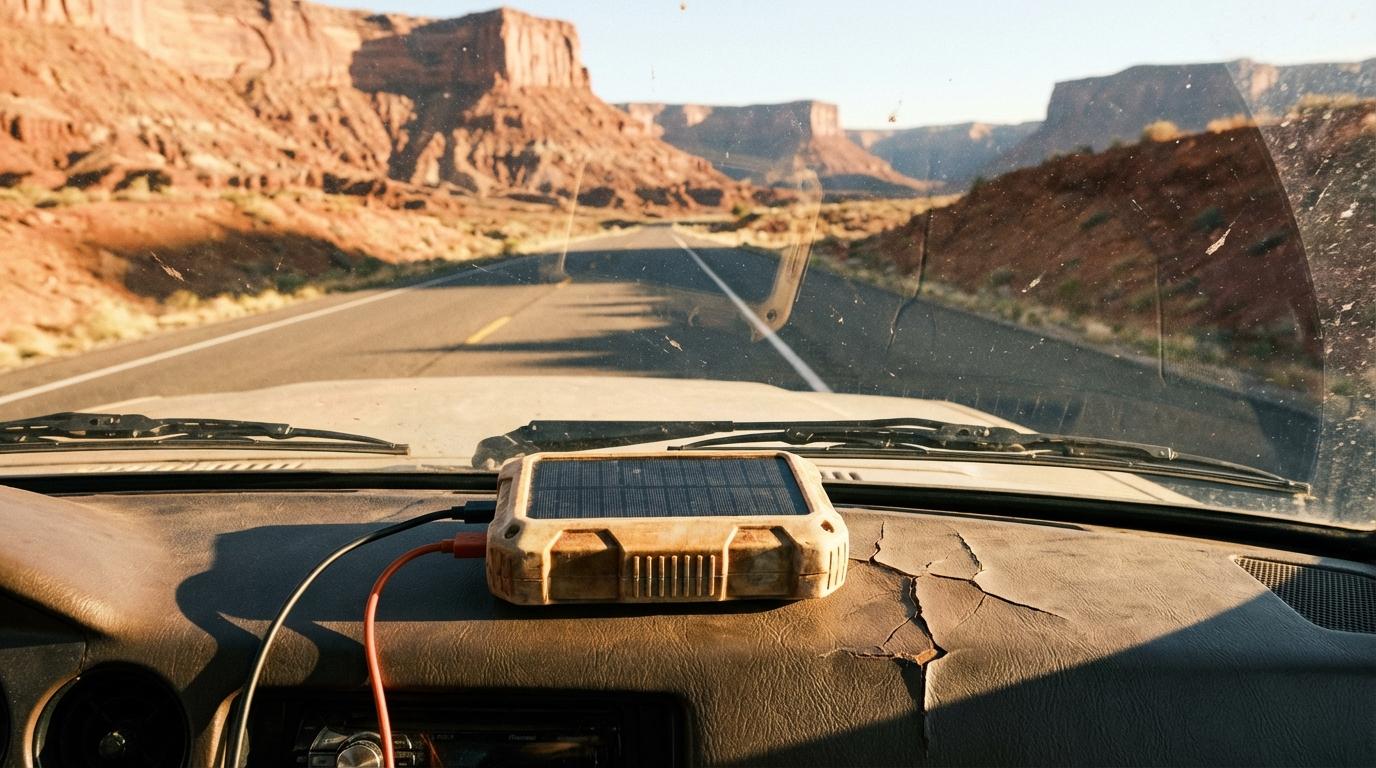
I used to think a forgotten charger was entirely the forgetter’s problem. Forget your cable and you spend the afternoon with a dead phone, and maybe next time you remember. I held that view for years and felt quite sensible about it.
Then Marcus got lost outside Page.
Somewhere Between Kanab and Page
We were running a loose convoy on the highway from Kanab down toward Page, red cliffs on both sides, air so dry my lips had cracked before lunch. Marcus was in the last car. His phone had been doing everything all morning: navigation on the dash mount, music through the car speakers, the weather app checking for storms over the lake. Nobody thought about his battery until he called our car to say it was almost gone and his cable was still on his kitchen counter at home.
We told him to just follow us. That sounded fine at the time.
What we didn’t account for (and I should have, because I had looked at the map the night before) is that the turnoffs on that stretch all look alike. One of them goes to the trailhead we wanted. The others are gravel tracks that wander off into the scrub and stop. A truck pulled in between us and Marcus at some point, we lost sight of his car, and he took the wrong turnoff. Within a few minutes he had no coverage, and not long after that his phone died completely. By the time we noticed he wasn’t behind us, there was nothing to call and nothing to look at.
We split up and drove back along the highway, checking each gravel road in turn, which took most of the afternoon because every one of them looked like the right one from the pavement. Eventually we found him parked at the end of a dirt track with the engine off and the windows down, sitting there with the kind of patience that made me feel worse than if he had yelled at us. He said he figured we would come back at some point. Fair enough, but “at some point” is a long time to sit alone in the desert with no way of telling anyone where you are.
A charged phone wouldn’t have gotten him a signal on that dirt track. It would have kept his navigation running, though, and his own map would have told him he was on the wrong road before he drove far enough to lose us.
What Navigation Does to a Battery
Turn-by-turn navigation is about the hardest thing you can ask a phone to do for hours straight. The screen stays on, usually at full brightness because you are reading it in direct sun, and the GPS is working the whole time while the phone keeps pulling map and traffic data over a mobile connection that gets weaker the further out you are. A weak signal makes things worse, since the phone burns extra power searching for a tower. Add music streaming and a hot dashboard, and a phone that comfortably lasted all day yesterday might be in trouble by early afternoon. You also won’t notice the drop, because you are watching the road, not the battery icon.
In a convoy every car is doing this at once. The lead car might know the route, but the cars behind it still need their own navigation for the moment a red light or a slow truck splits the group. So if nobody planned for charging, you are not risking one dead phone, you are risking several around the same time.
Whose Turn Is It on the Cable?
Most cars have a port or two somewhere near the center console, and in a full car that turns into quiet rationing. The driver’s phone is running navigation, so it gets priority (nobody says this, everyone knows it). Up front, the passenger might be handling music or texting the other cars. Meanwhile the people in the back watch their screens fade and try to decide whether asking for a turn on the cable makes them look needy, which is a ridiculous thing for grown adults to be weighing up on a road trip, but here we are.
A multi-port adapter for the 12V socket helps, with a caveat. Cheap ones charge so slowly that a phone running navigation barely holds its percentage while plugged in, and the back left seat is out of reach unless someone brought a very long cable.
Why One Dead Phone Becomes Everyone’s Problem
The person with the dead phone can’t see where the group is going anymore. They can’t tell anyone they need gas, or that the noise their car started making earlier now smells like something burning. On top of that, they drop out of the automatic alerts a convoy app sends when someone stops or falls behind, because those alerts depend on their phone reporting a position. The rest of the group is left guessing about one car.
There is a difference worth knowing here between a phone with no signal and a phone with no battery. In Konvoyage, when someone loses connection their dot fades on everyone else’s map and shows “no signal” along with how many minutes ago their last position came in. If their phone is just out of coverage, it keeps recording positions and sends them once it finds a signal again, so the gap fills in later. A dead phone records nothing. The faded dot looks the same either way, which is why you want to rule out the battery before the trip starts rather than wondering about it on the shoulder.
Then the group has to decide what to do. Everyone pulling over to wait means the whole convoy stops. When someone goes back to look instead, the group is now split in two, and if you try to arrange a regroup point over the phones that still work, the drivers are doing logistics while driving. Once it gets dark it is more serious, because a dead phone also means no flashlight and no way to call for help if that car breaks down on an unlit road.
What I Pack Now
After that trip I started carrying a proper power bank on every group drive. Not one of the slim tubes that gives you half a charge and then becomes dead weight in your bag, but an Anker 737, which is heavy enough that you notice it and holds enough to bring several phones back from empty. It lives in the center console of my car, wrapped in its own braided cable, next to a spare USB-C cable for whoever turns up without one. (Yes, I am the person with spare cables. I’ve made my peace with it.)
One power bank in my car does nothing for the car that is miles behind me, though, so I treat phone power as something the group sorts out together rather than something each person handles alone. If everyone’s phone can run navigation all day while plugged into their own car, you are fine. A car with only one port and more than one person who needs it needs an adapter that actually keeps up with navigation, not the gas station one that charges at a trickle. When someone’s cable doesn’t fit the car’s port, or nobody in a car has a cable at all, that is the car that gets the spare power bank before you leave. And if you can’t fill that gap before departure, put the person with the weakest setup in a car with someone who can share, or at least make sure they aren’t the ones driving last.
Every person carrying their own power bank would be nice (it won’t happen), so I settle for every car having at least one.
The Message I Send the Night Before
Charging is boring next to choosing the route or arguing about the playlist, but I put it in the same group chat message where we confirm the departure time and agree on how your group will communicate on the road. Something like: “Make sure your phone can stay charged for the whole drive, we need everyone’s navigation running. Tell me tonight if you don’t have a cable that works in your car.” Asking it that way gets a better answer than “did you charge your phone?”, because a phone at full charge at breakfast still won’t last the day without a cable.
On longer drives, especially when you are on the road for several days in a row, I plan charging into the stops. When we stop to eat, everyone plugs their phone and their power bank into whatever outlets the place has while we order (ask first, most diners don’t mind). It sounds overly organized right up until you have spent an afternoon checking gravel roads for your friend’s car.
If you are organizing, keep a charged power bank and a spare cable in your car that are not for you. Marcus still brings this up whenever someone asks to borrow mine.