The end card said 1,363 km. Danielle looked at it for a second, opened the calculator on her phone, and wrote 847 miles across the screenshot in red. By the time I came back from the motel ice machine, that screenshot was the group chat picture.
That drive was my plan, start to finish, and I had told everybody it was “about 700 miles, tops.”
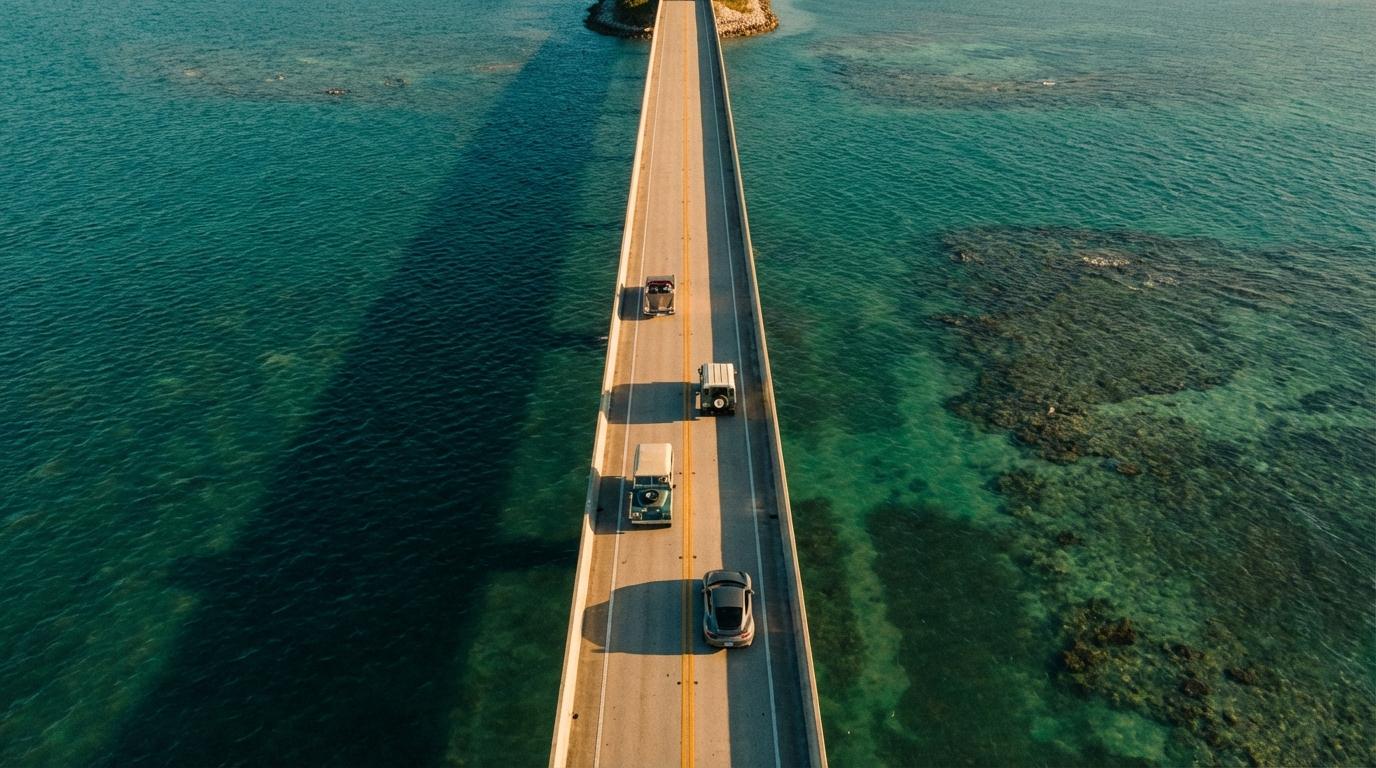
Some background. Every Labor Day weekend our group drives somewhere too far away, and last year it was Charlotte to Key West in three cars. I set it up as a trip in Konvoyage like I always do, mostly so nobody has to call the lead car to ask where it went. When the last of us pulled into Key West, the trip ended on its own. A replay link showed up on everyone’s phone a little later.
Danielle opened it on the motel bed and played the whole drive on the fastest speed. Our three cars crawled down Florida as one little clump. She narrated it like a nature documentary, mostly at Kev’s expense, right up until the card came up.
My 700 miles did not survive the card
When the replay finishes, you get a card with the trip name, the distance, how long the drive took, how many of us were in it and how many chat messages we sent. It also says who arrived first. That was Theo, in the car that was mostly luggage, and he has brought it up at every dinner since.
The distance is in kilometers. My app is set to miles, but the replay page shows km regardless, and nobody in our group thinks in kilometers, which is why Danielle needed the calculator, and why for about a minute I hoped the number was a mistake.
It wasn’t.
I had worked out my estimate from the route on my laptop weeks before. What I didn’t count was a gas station that turned out to be closed, which we found only after a long crawl off the highway, and a slow loop around Miami because Theo and I both missed the same exit.
Who drove further
This is where it got useful. Theo spent the whole drive down claiming the luggage car had done the hard part, that they took the long way around the traffic and covered way more ground than the rest of us. He was very sure about this. There was a whole speech, with hand gestures, delivered at a Buc-ee’s.
The Timeline panel on the replay page lists each person at the bottom with their own km next to their name. Theo’s number was within a few km of mine.
So, no. He hadn’t.
To his credit, he took it well for most of a beer. Then he started arguing that his own km was low because he’d been the one carrying the cooler to the car at every stop, and walking doesn’t count, which is not how any of this works. Danielle screenshotted the legend too. That one did not become the group picture, but she keeps it in a folder for later use.
I assumed at first that the figure on the end card was all of us added together. It can’t be, with that many phones spread over three cars it would have been several times bigger. As far as I can tell it’s about what a typical one of us drove, which is the number you want when someone asks how far the trip was.
Kev joined at the first gas stop
One thing I’d change. Kev forgot to join the trip in the driveway and only typed in the code once we stopped for gas, somewhere past the state line, so his km in the legend is shorter than everyone else’s and his dot only appears partway into the replay, with his join time sitting in the timeline well after ours. The replay can only count what your phone sent while you were in the trip. If you care about the number at the end, make everybody join before the first car pulls out. It takes a minute in the driveway.
Screenshot it the same night
Replay links work for 30 days. After that the link stops working. Danielle’s mom found that out in October when she went back to show the dots to her neighbor.
I didn’t think about that at all until Danielle’s screenshot became the only thing in the chat anyone cared about. Our earlier Labor Day drives never had a number. We did Savannah one year and Nashville the year before that, and the only record of how far we went is my guess and Kev’s retelling, which has gotten longer every time he tells it. Nashville is apparently now an all-day drive. It was not. I can’t prove that, and that bugs me more than it should.
The rest of the replay page is worth a look before it expires too. There’s a timeline with clock times for every chat message and for when each of us arrived, and I went through what that timeline tracks in an earlier post. For us the timeline settled the question of who sent “Wait for me” outside Jacksonville. It was me.
I’ve also written about sending the replay to people who weren’t there, like Danielle’s mom, who watched the dots and texted back asking why we stopped so often. The screenshot stayed inside our own group chat, with no caption, and it got more replies than any photo from the actual beach.
We did a proper debrief over fish tacos the next night, and the number kept coming back into it. Kev wanted to know how many of the 847 were his fault. Theo wanted it on a shirt.
Next year I’m setting the drive up in Konvoyage again, and I’m screenshotting the end card myself the minute we arrive. Before Danielle gets to it with the red pen. Also before I start telling people how far it was, because I’ve learned I’m bad at that.
A week ago Danielle texted the group: “Labor Day planning starts NOW. Find us somewhere that beats 847.” Kev suggested Montreal, so I checked it on the map. It’s further. I haven’t told him yet.