After the pie plates were stacked in my mother’s sink and the dishwasher had started its low grumble, I sat on the arm of the couch and opened the replay link from our Thanksgiving drive. I only wanted to check whether my brother-in-law had actually joined the trip that morning or just said he would. The page loaded in my browser, the map slid into place over the stretch of interstate we had all driven that morning, and on the right side there was a narrow panel labelled Timeline. It was a scrolling list of what had happened on the drive, with a clock time beside every line. He had joined, for the record, a good while after the rest of us.
I lost most of the evening to that panel.
My sister found me there when she came looking for the whipped cream. She leaned over my shoulder, smelling faintly of cinnamon and dish soap, and read along while the kitchen got loud behind us. Somebody’s kid was crying about the dog under the table. We scrolled through the morning together, and she kept saying she remembered it differently, in the tone she uses when she already suspects she doesn’t.
Where the Timeline Lives
I looked for it inside the app first, which was wrong. After a trip ends, everyone who was on it gets a replay link, as a phone notification and again in the trip summary email, and tapping it opens a page in your browser. The whole drive plays back on a map there, each car a moving dot on the roads it really took, and you can speed it up or drag the slider to any point you want. Off to the side of the map is a drawer, and that is where the Timeline sits. You can share the link with someone who wasn’t in the car, and it keeps working for 30 days before it expires, which matters if you are the kind of person who plans to bring evidence to Christmas.
What Actually Shows Up in It
The top line says Trip created, stamped with the moment whoever organized things tapped the button. Under that, each person who joins gets a line with their first name and the time they connected, so you see when people really got on board rather than when they texted that they were on their way. Messages from the drive land in the list as well, the typed ones and the quick ones like Stopping for gas or Taking a break, with the sender’s name in front. If someone asked the group to wait, or told everyone to go ahead without them, that is in there. Police reports appear as their own entries, and a pin drops on the replay map where the speed trap was spotted. Arrivals come last, each person with their own clock time, and when the replay finishes the closing card names whoever arrived first.
Filter chips at the top let you narrow it down, so you can hide the messages and look at only the joins and arrivals, or the other way around. Tapping any line jumps the replay to that moment and the dots rearrange themselves to where everybody was right then. I did this far too many times, tapping my sister’s gas message and watching her small coloured dot peel off toward an exit ramp outside Knoxville while mine kept rolling down the interstate, past the billboard for the fireworks outlet I remember from the actual morning because the sun was hitting it so hard it glowed.
It doesn’t log when somebody’s phone loses signal in a dead zone, which I had half expected it would, so a quiet stretch in the hills leaves nothing in the list.
The Trip Chat Is in There Too
You know what a road trip group chat looks like by the time you park. Half-typed messages go out at red lights, and somebody asks which exit and gets a different answer from every car. On Thanksgiving morning I was reading ours in the passenger seat with the heater blasting on my shins and a podcast about a cold case murmuring from the speakers, trying to work out from a string of thumbs-up emojis whether my sister had stopped or not, and I gave up somewhere around the state line.
Messages sent inside the trip sit in the Timeline in order between the joins and the arrivals, each with its clock time. My brother-in-law’s “right behind you guys” had gone to the family text thread instead, and its timestamp sat on my phone next to the much later time he actually connected, while the oven timer went off in the next room.
Settling It at the Table
Every family has a road trip argument that comes back every holiday, and ours is about who held everyone up on the way to my parents’ house. My sister and my brother-in-law have taken turns blaming each other for years, both insisting they were ready on time, both pulling my parents into it on the strength of no firsthand information whatsoever. The arguments never end because nobody has proof, only memories that get more dramatic and more flattering with every retelling. My dad usually ends it by asking for the gravy.
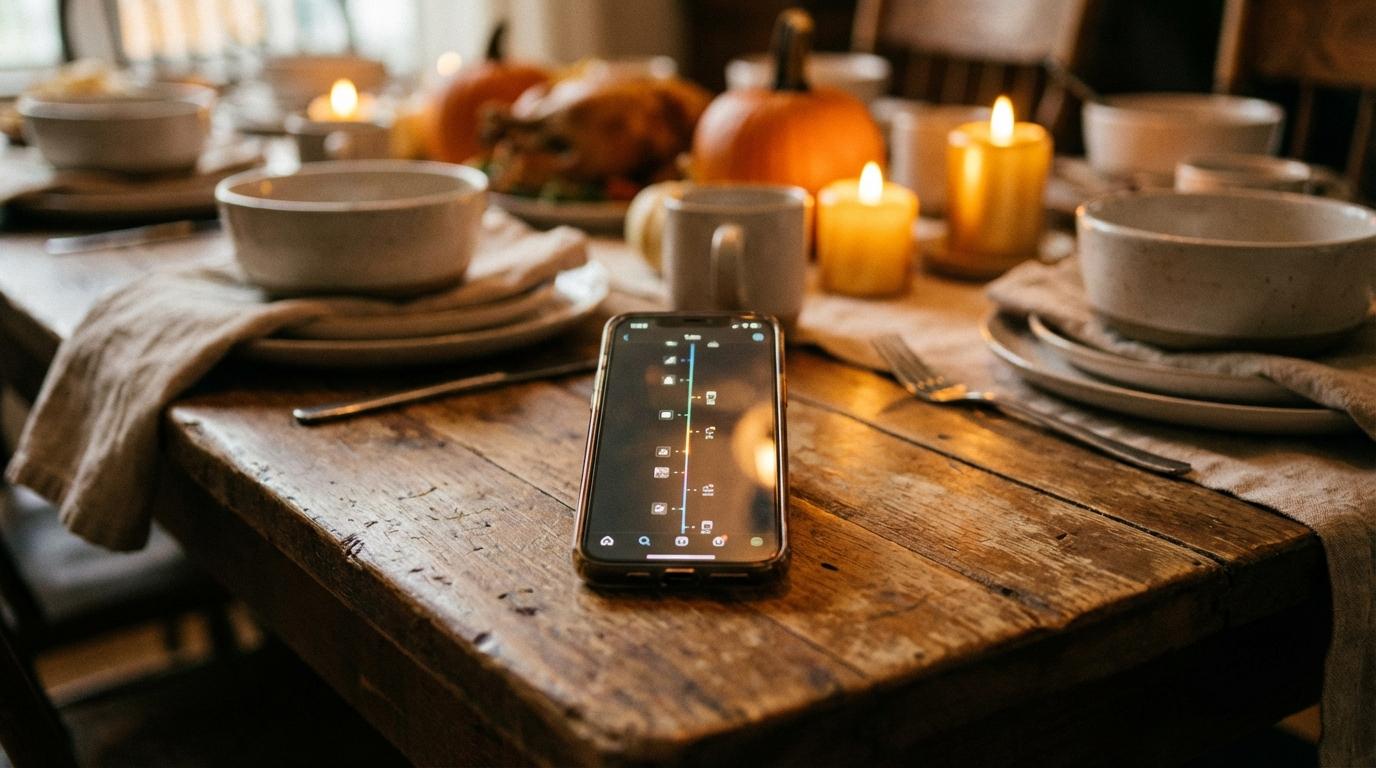
This year I put my phone in the middle of the table, between the cranberry sauce and the bread basket, with the Timeline open to the joins.
My brother-in-law looked at the screen and then at my sister and said, “Okay, that’s fair,” and went back to his turkey. She looked a little too pleased about it, which lasted right up until I scrolled down and found her Stopping for gas message, sent twice, with a good chunk of Tennessee between them. According to her she asked for gas exactly when she needed it and not a minute before. The list disagrees, and I showed her, and she was not thrilled.
It is a petty use for a trip replay that keeps a timeline of the drive, and our argument had come back every holiday for years because nobody could produce anything to look at. A list of first names and clock times turned out to be surprisingly hard to argue with when you were sitting across the table from it with a mouth full of stuffing.
The part I didn’t expect was how much nicer the conversation got once the blaming was over. We ended up replaying the whole morning at the fastest speed, laughing at how our dots bunched up and drifted apart and bunched up again at the same rest area outside Chattanooga, where the coffee tasted burnt and the bathroom hand dryer was so loud my niece had covered her ears. Going back over a trip together afterward was something we had never done before, and my niece made us restart it so she could watch her dad’s dot miss the exit again.
My mom asked if she could get the link so she could watch it again later on her own.
I forwarded her the email that night, still on the arm of the couch, with the dishwasher clicking over into its dry cycle and the house finally going quiet.
Christmas
At Christmas my sister created the trip for the drive back to my parents’ place, sent the code to the family chat, and my brother-in-law joined almost before her message had finished sending, while the rest of us were still finding our shoes. He told me this himself at dinner, unprompted, leaning across the mashed potatoes like he was revealing a plan he had been working on since November. “Check the timeline,” he said, pointing his fork at my phone, so I opened the replay right there, and his name sat directly under Trip created, ahead of everyone. My sister read it over my shoulder, said nothing at all, and got up to get more gravy.