The calls started before my first coffee.
I managed a crew of 8 delivery drivers for a regional distributor outside of Charlotte, and every shift opened the same way. A customer called dispatch, dispatch called me, and I called the driver to ask the question all of us knew was coming, which was where he was.
On a typical shift I fielded more than 30 of those calls. Nobody in that chain was being difficult or trying to micromanage anyone. We just didn’t have the same information at the same time, and the phone was the only way any of us had to move it around.
It took me a long time to notice that nobody calling actually cared where the driver was. Whether he was on Oak Street or stuck behind a train on the bypass near the old cotton mill made no difference to the person waiting on a pallet at the back door. They wanted a time. Location was a rough stand-in for arrival, and a bad one, because “about ten minutes away” only means something if you trust the driver’s guess and can picture traffic you can’t see. Most people didn’t bother with that math and just called back later.
Forty-five minutes a day as a human relay
Each call ran about a minute and a half. Add that up across a shift and I was spending close to 45 minutes a day turning a dot on a map into a spoken guess and passing it down the line by phone. I wasn’t solving anything or deciding anything in that time.
The drivers paid more for it than I did. A driver backing into a loading dock doesn’t need his phone buzzing on the dash, and neither does a guy hunting for house numbers in a neighborhood he’s never seen. Each interruption cost a little time, which pushed the afternoon stops later, and then the customers on those later stops started calling to ask where their driver was.
I know what that’s like from the driver’s seat. Before I ran the crew I drove a box truck on the same territory, and in January the heater didn’t put out anything warm until midmorning. My phone sat in a cracked dash mount that rattled over every rail crossing, and when it rang I had to pull a glove off with my teeth to answer. Usually it was dispatch, asking where I was.
One of my drivers, Marcus, said it better than I could have. I had called him mid-route on behalf of a customer, and after he gave me a rough time, he added one more thing. “You called me to ask where I was while I was literally watching my dot move on your screen.”
He had a point. I had the live tracking dashboard open the whole time, with his dot moving toward the next stop in plain view, and I picked up the phone anyway because that’s what I’d done for years.
Most field teams already carry the tracking hardware they need in their pockets, and mine did too, so the hardware was never what held us back. I just hadn’t gotten into the habit of looking at the screen before dialing.
A dot makes you do the math
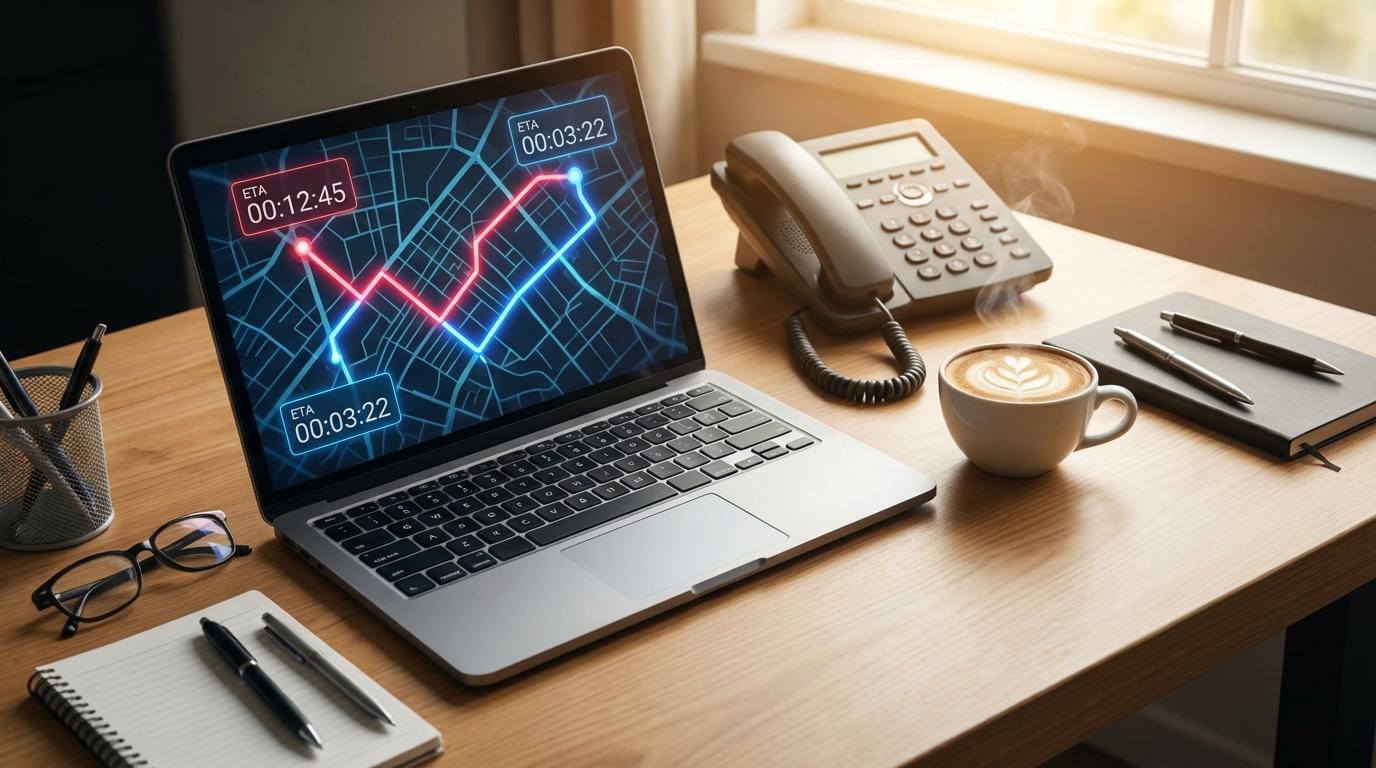
Switching to live ETA tools is what finally quieted my phone. Instead of a dot everyone had to interpret, each driver had an arrival time that kept updating as he drove. With a dot you still have to know the roads and guess at traffic you can’t see from an office chair. The arrival time gave people the number they had been calling to ask for in the first place.
When I rolled it out across the crew, call volume fell hard within the first few days. Dispatchers could see arrival times without picking up the phone, and I could check any delivery without interrupting the driver making it. Customers who got a tracking link mostly stopped calling at all. Before, one customer question meant three phone calls, and one of them pulled a driver off his work. After, a dispatcher glanced at a screen and read the time back to the customer while the driver kept unloading. I didn’t have to get involved unless something had actually gone wrong.
My hand still goes for the phone
Months later, I still get it wrong. A customer calls dispatch, dispatch pings me, and I’m halfway through dialing the driver before I remember the answer is already on my second monitor. I catch it most of the time, not every time. The embarrassing part is that I’m the one who told the dispatchers to check the screen before they call anyone.
It also took me weeks to stop treating a quiet phone as a warning sign. When a driver hasn’t called in for a couple of hours, my gut still says something’s off, even when the screen shows him right on schedule.
Marcus stopped keeping his phone in the dash mount. He moved it to the cupholder, face down, and told me he’d gone a whole afternoon without it ringing once.
We still make plenty of calls during a shift. Drivers call about a locked gate or a receiver who went to lunch, dispatch calls about last-minute schedule changes, and I call when weather closes a road. Those calls are about real problems, and somebody usually has to make a decision at the end of them. The one that dropped out is the call asking where somebody is, which is the same call road trip groups keep making to each other from car to car.
Not long ago a new dispatcher, still in her first week, took a call from a customer asking about Marcus. She had the phone halfway to her ear to ring him when she stopped, looked at the screen, and told the customer four minutes. Then she hung up and went back to the route sheet she’d been fixing, and a little while later Marcus was backing up to their dock.