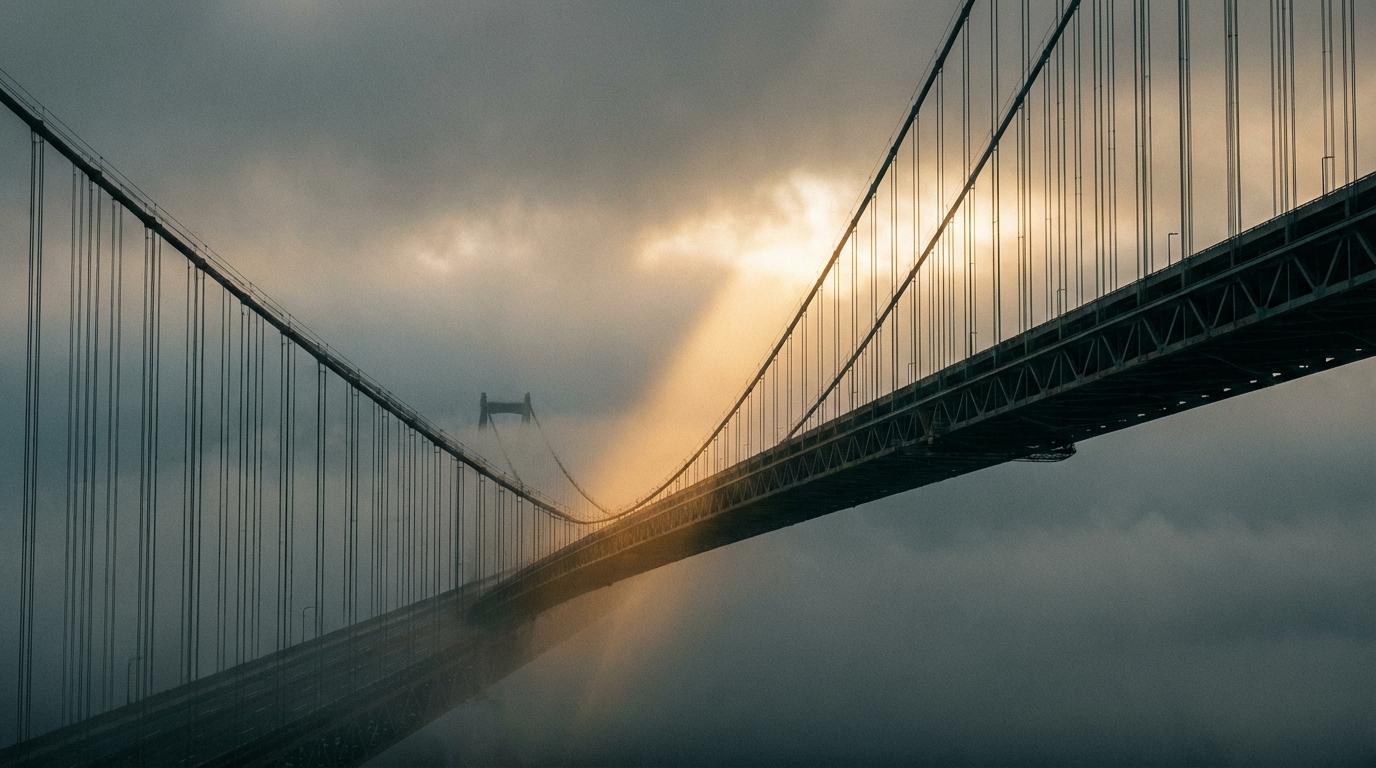
The Mackinac Bridge is five miles of steel over the Straits of Mackinac, and the first time I crossed it I was a kid in the backseat of my dad’s old station wagon. My mom drove. Halfway across, a gust pushed the car sideways without her touching the wheel, and her knuckles went white. I remember the hum from the steel grating in the inside lanes, a vibration you feel in your teeth before you hear it.
I pressed my forehead to the window and stared at the water. Nobody in the car said a word until we were back on land.
Years later I led a convoy across a long bridge in maybe half that wind, and I still panicked in front of everybody.
The accordion I caused
The sky was gray, I had a tidy line of cars behind me, and when the deck started to move my brain told me to brake. Not a hard stop. Just the reflex tap your foot does when the road shifts under you. Everybody behind me braked too, and the driver at the back braked hardest because all she could see was brake lights.
By the time it rippled back, the last car was nearly stopped in a travel lane with a semi blowing past in the lane next to her. That was Jess. At parties she still brings it up, complete with a brake-squeal sound effect.
Open the gaps before the on-ramp
The Mackinac Bridge Authority publishes specific wind thresholds for its span. In moderate gusts it escorts high-profile vehicles across, and when the wind gets high enough it closes the bridge. A sedan is not a box truck, but a long deck still means a long stretch with nothing between you and a crosswind. On the Mackinac the steel grating adds its own wobble, because tires wander a little on it even on a calm day.
Wind changes how much room you need. On a normal highway I tell people to leave about 3 seconds behind the car ahead. Out on a long bridge in wind, I ask for 5 or more. That extra room is what absorbs a gust or somebody’s panic brake. Mine, for example. Set it on the approach, while you’re still on solid ground, because easing off with a rail a few feet from your mirror is harder than it sounds.
Tell the group at the last stop before the bridge.
Don’t plan on stopping up there either. Most long bridges have a narrow shoulder or none at all, and a stopped car on the deck creates a bigger problem than whatever made you want to pull over.
Priya and the causeway
My friend Priya rode with me across a long causeway one winter. I didn’t know until we were already on it that bridges over open water scare her badly. She asked me, very quietly, to talk about anything except the water.
So I talked about a bakery in Lisbon with blue tiles on the walls and the ovens going at 6 a.m. I described the custard tarts in far too much detail, then the guy behind the counter who never once smiled at me in a week of visits. By the time I ran out of bakery, the tires were back on land. Priya exhaled hard and asked if the bakery was real. It is.
Ask before you cross. Somebody in your group might hate bridges and never say so unless you give them an opening, and it’s a lot easier to seat that person next to a talker at the gas station than to find out at mile two.
Toll plazas, the ambush at the end
You made it over with your spacing intact. Then the toll plaza shows up, the lanes split, and a couple of them turn out to be closed, which you can only see a few seconds before the gate.
Pick the lane early. If you know the plaza, agree on the lane at that last stop and let everyone drift over gradually instead of lurching at the end. Group texts at highway speed are how phones end up in laps. A tool built for live location sharing during group drives shows you where everyone is on the map before the split, which is enough to pick a lane without a conversation.
Sometimes one car still lands in the wrong lane and comes through the gate a minute behind everyone else. That’s the same mess as a red light cutting the group in half, and I wrote up the mechanics of a convoy split separately.
Our rule now: after any long bridge, everyone pulls into the first parking lot on the far side for a few minutes. Nobody has to explain whether they were nervous. Jess usually gets out and does the brake noise anyway, and then we go.