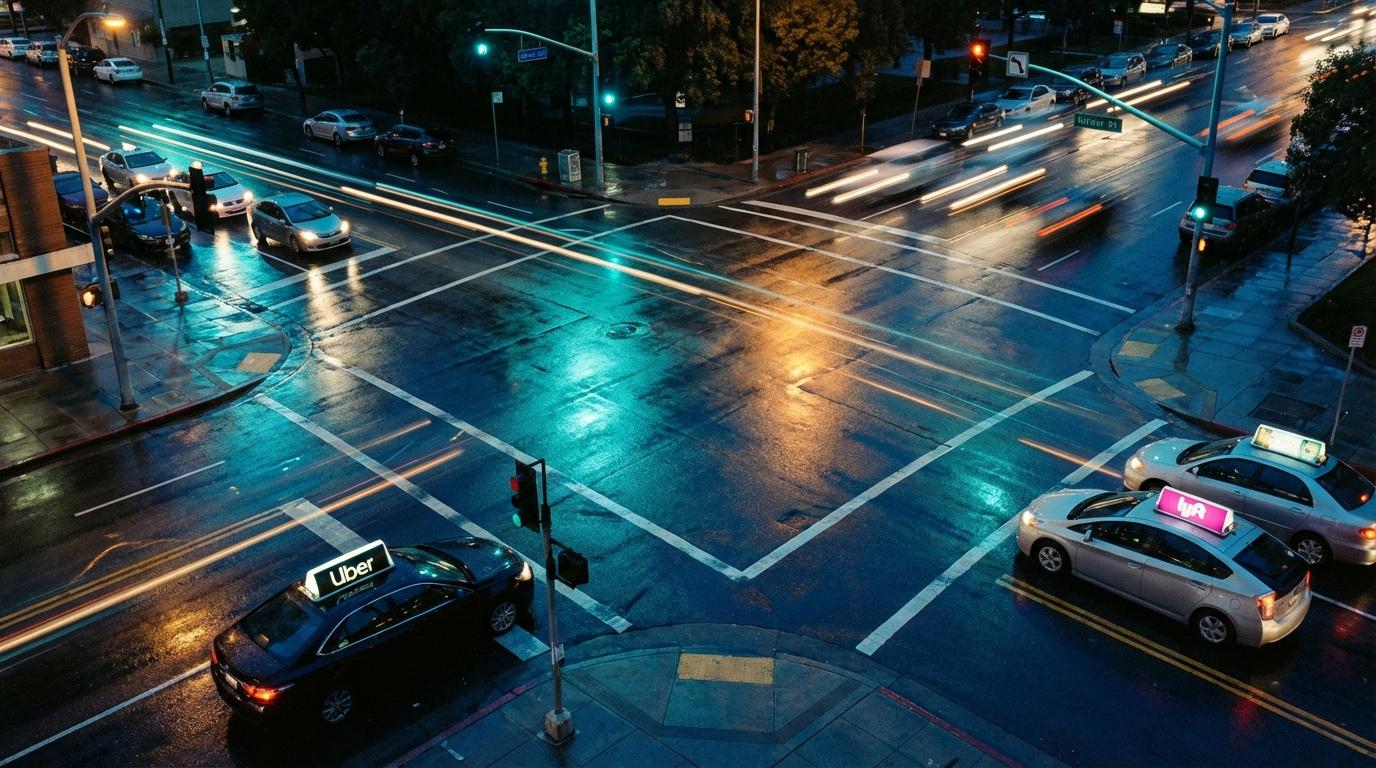
Would knowing exactly where every other driver in your rideshare fleet is at this exact second actually make any of them better at their jobs?
I keep coming back to that question, mostly because I am, embarrassingly, the kind of person who opens a rideshare app at midnight and stares at the little cars circling the block near my apartment. Not to book anything. Just to look. (I know. It is borderline creepy and I am working on it.)
That habit is why I have opinions about driver-to-driver visibility, and also why I don’t fully trust them.
What does coordination look like at street level?
On a whiteboard the pitch is easy. Drivers who can see each other stop stacking up at the same corner, and at a crowded venue they can sort out who takes the next pickup without dispatch stepping in.
I have a friend who used to drive me home from the airport on weeknights, back when she was doing it full time. She kept a clipboard in the glove box (an actual clipboard, which I found charming) with notes about which terminals had decent cell reception. When this topic comes up, she is the person I picture. Her view, roughly, was that seeing the other cars would have made her a worse driver. She would have spent the shift scanning the map when she should have been watching the road. What she wanted was a blob of color showing where pickups were dense, and nothing about who was parked where.
I think she was right about that. Knowing the neighborhood is busy is useful. A dot telling you that Marcus in the silver Camry is around the corner from you mostly gives you something to stare at.
If they can see each other, what do they do with it?
Run it forward. If a driver sees another car circling the same hotel, maybe she peels off to a different zone, or maybe she decides that hotel must be busy and stays. When she peels off, the cars spread out the way the whiteboard promised. If she stays, and so does everyone else who had the same idea, you now have a parking lot full of drivers watching each other and nobody across town.
A softer signal (colored shading instead of car icons) changes the questions without answering them. Drivers who trust the shading might behave better. If they ignore it, you shipped a feature nobody uses, and you learn less from that than from one people misuse. Some of this overlaps with what location apps actually expose to other users, since the question of who sees your dot and what they can work out from it doesn’t change much between a group of friends and a fleet.
Territory, and the part nobody puts in the sales deck
Drivers are not enemies. Most rideshare drivers I have talked to are decent, tired people trying to hit a number before the end of the shift, and the competition angle gets oversold by people who have never sat in a parked Honda Civic at 2am waiting for an airport queue to thin out.
Still, once drivers can see exactly where the others are, every decision they make gets weighed against everyone else’s. Some will park themselves between a competitor and the next likely pickup. Others will back out of areas that look taken, even when there are plenty of riders waiting.
My friend said something else that stuck with me. Her worst nights were the ones where she thought she knew where everyone was and didn’t. She had a picture in her head built from scraps (a car she’d spotted twice, a guess about where the bar crowd was headed), and it was already steering her choices. A real map, she figured, might have made the bad guesses feel official.
I am bad at remembering this myself (see: the little cars near my apartment).
The privacy question that gets skipped
Most fleet conversations treat driver privacy like paperwork for HR, and I think that undersells it badly.
If drivers can see each other, then every driver is visible to every other driver on the platform, all shift, every shift. Being watched by one dispatcher in a back office is a different arrangement. A dispatcher has a job description and a manager. The other drivers are dozens of strangers with their own reasons for looking, and some of them will be screen-recording.
Say a driver tells dispatch she doesn’t feel safe in a certain neighborhood. That’s a private conversation. If she just quietly stops showing up there on a shared map, anyone paying attention can piece together where she goes and when she logs off, and she never agreed to tell them.
And if she wants to sit in a parking lot for a while and eat a sandwich, does she get to do that without the rest of the shift watching her dot stop moving?
Then there is surge gaming, which is the part that should actually worry anyone running one of these platforms. Once drivers can see each other, they can spot when an area is thinly covered, and if they can see that, they can agree to leave it empty on purpose. Drivers have coordinated informally for years through group chats and meet-ups in parking lots before big games. Putting the map inside the official app takes away the effort that used to slow this down. I would be careful about removing that effort.
Picture a concert letting out with twenty drivers in range, all able to see each other. Someone in a side chat suggests everyone hold position for five minutes so surge pricing climbs. If enough of them go along with it, riders pay more, drivers make more on the next trip, and from the outside the platform looks like it has too few cars when what it actually has is cars that agreed to wait.
You can blunt it by fuzzing locations or showing zones instead of cars. Those help, partly. I haven’t seen anything that fixes it outright.
If I ran the ops team tomorrow
I would sort it by what you are trying to fix.
If the goal is fewer drivers piling onto the same venue pickup, show density and leave identities out. Nobody needs Marcus’s exact spot to work out that this corner is crowded and the next block isn’t, and a heatmap shows that fine.
For bad weather or an incident on a major road, I’d turn on visibility temporarily, make it opt-in, and have it switch itself off when the event is over. Whatever the default is, that’s what most drivers will live with, because almost nobody goes into settings to change it (I do, but I am not normal about settings).
If the goal is letting drivers help each other with a flat tire or a sketchy pickup, build a way to ask for help and answer it. The rest of the shift would see a request when one comes in, and nothing else.
And if the goal is getting drivers to feel like a team, a map won’t do that. I say this with some affection for the operators who keep trying anyway.
Tonight I will probably still peek at the cars near my apartment.
But would I want my own driver doing the same thing while she’s supposed to be watching the road?