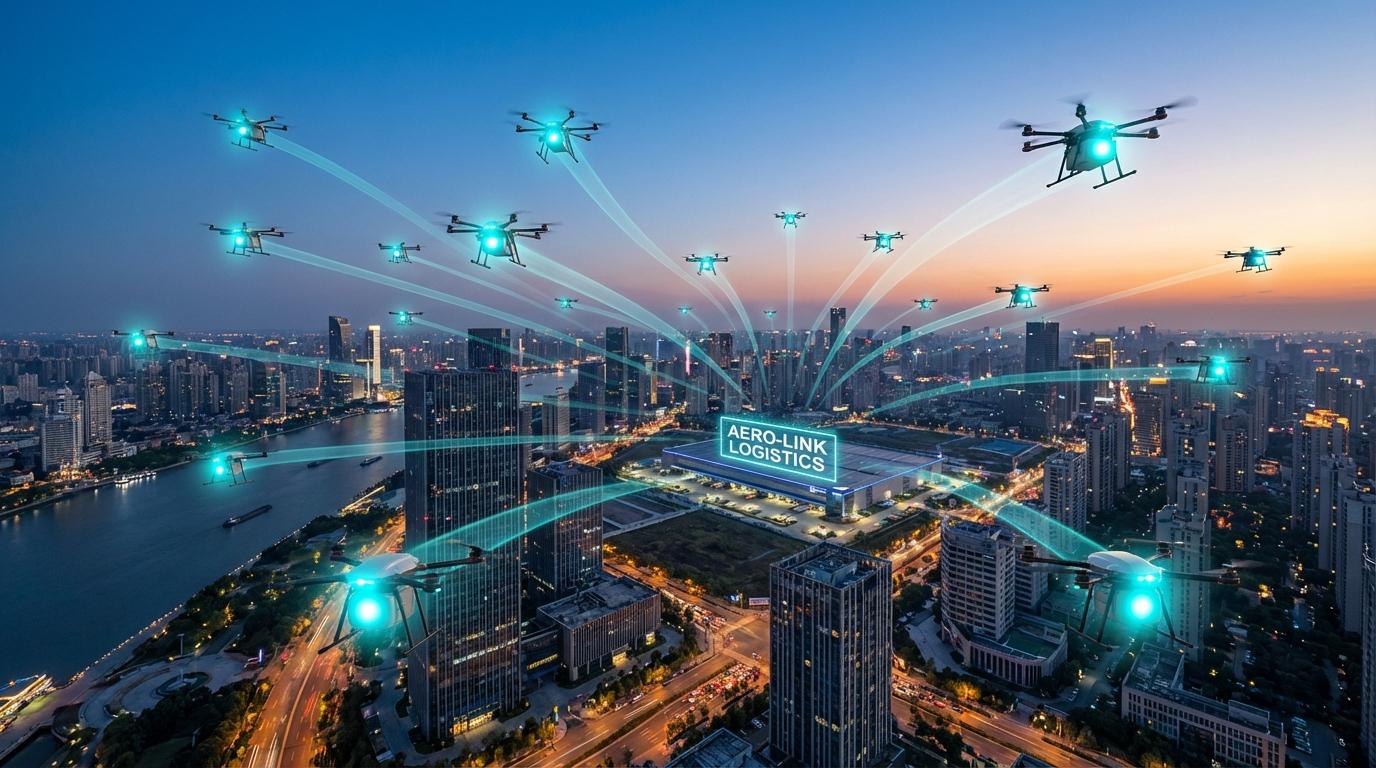
A delivery drone works out its own position from satellite signals several times a second and sends it down over a cellular modem, and from there it takes a server and an app on your phone to turn that into the little icon you watch crossing your neighborhood. Science fiction promised us flying cars. What we got was a cardboard box of deodorant hanging under a machine that sounds like an angry lawnmower, and I’d argue the box is more useful.
I used to assume tracking one of these was basically like tracking a delivery van from higher up. Put a GPS chip on it and draw a dot on a map. It took me a while to see how wrong that was, and most of what changed my mind was learning how little a drone can lean on the things that make ground tracking forgiving.
A van has a road, and that helps more than people think. Even when its GPS fix wanders, the software can assume the van is somewhere on that road, and a van that drifts a couple of meters ends up against a curb. A drone that drifts the same amount can end up in a tree or over the neighbor’s fence, with no lane to snap it back into.
GPS, but Not the GPS You Know
Every delivery drone carries a GPS receiver, and that part works the way it does on your phone: it listens to satellites and calculates a position. When a friend checks your ETA on a shared map instead of calling to ask where you are, the dot they see is usually accurate to within a few meters. On the ground, that’s good enough for nearly anything you’d want to do. Your phone knows you’re on Main Street even when the raw coordinates put you inside the coffee shop next to it, because map matching quietly moves you onto the nearest road.
Up in the air, nothing quietly corrects the position for you.
Many delivery drones add RTK (Real-Time Kinematic positioning), which compares the satellite signals against a fixed ground station at a known location and uses the difference to correct errors down to centimeters. The receivers cost a lot more than the chip in your phone. They also tend to listen to several satellite systems at once, GPS alongside GLONASS, Galileo and sometimes BeiDou, so a building that blocks one set of satellites doesn’t leave the drone guessing.
Getting the position off the drone
Knowing where the drone is doesn’t help anyone if that information stays on board. In towns and suburbs most delivery drones use ordinary cellular modems on the same networks your phone uses, sending position, altitude, speed, heading and battery level back to base, often about once per second.
The odd part is that cell networks were built for people on the ground. Tower antennas aim their signal outward and slightly down, toward streets and buildings, so a phone at street level usually hears one or two strong towers. A drone a hundred meters up can hear many towers at once, none of them pointed at it, and their signals interfere with each other. Operators have had to work on antenna setups and signal handling just to keep the link steady at altitude. I found that more surprising than anything on the GPS side, because I’d always thought of losing coverage as something that happens when you drive up into the hills, not when a machine rises a hundred meters above a suburb.
What Happens Between the Drone and Your Screen
The chain from the drone to the moving dot is longer than it looks. On board, the flight controller filters the jitter out of the raw GPS readings before the modem sends the cleaned-up position along with the rest of the telemetry. Once it reaches the operator’s servers it gets checked again and pushed out to your app over a live connection such as a WebSocket. In good conditions all of that takes under two seconds.
The bit I find most interesting happens on your phone, though. Your screen redraws dozens of times a second, while new positions arrive about once a second, and if the app only moved the icon when fresh coordinates came in, the drone would hop across the map in jumps. Instead the app interpolates: it takes the last known speed and heading and animates the icon along the path the drone is probably on. When the next real position arrives, a good app eases the icon over to it rather than snapping (the jerky, teleporting look on some tracking maps is usually a display choice, not a GPS fault). There’s a tradeoff buried in that, because predicting ahead keeps the motion smooth but means the icon is sometimes showing a guess. If the drone slows down to hover over your yard, the prediction overshoots for a moment before the correction pulls it back, and the trick is to blend that correction in gradually enough that you never notice it happened.
Cleaning up noisy position traces from moving things shows up all over mapping. It’s a big part of how map providers collect road data from the GPS logs of cars driving around, too.
Remote ID, the Tracking You Never See
While the operator tracks its drones to get packages delivered, each drone is also feeding a completely separate tracking system that has nothing to do with you. In the US, the FAA requires drones flown commercially, and most heavier hobby drones, to broadcast Remote ID, which works like a license plate the drone keeps announcing into the air.
The broadcast goes out over Bluetooth and Wi-Fi and carries the drone’s ID, its position, altitude and speed, plus the location of the control station, so anyone nearby with a compatible app can pick it up. An earlier draft of the rule would also have routed the data through the internet to approved services, but the FAA dropped that from the final version (people often assume the FAA watches every drone live on some central screen; the requirement is a local broadcast). Remote ID keeps working when the cellular link drops, since it never depended on that link.
For the operator, the tracking feed matters for more than the customer’s map. A control room might watch many flights at once, each one a stream of position, battery, wind and signal strength, and someone has to notice when one of those numbers starts drifting.
When the signal disappears
Cellular coverage has gaps, and drones fly through them more often than you’d expect, especially when descending between buildings or crossing rural stretches where the towers were placed with ground users in mind. The usual approach is for the drone to log its position locally and upload the buffered data once it reconnects. On your end, the app might freeze the icon at its last known spot with a connection warning, or it might keep predicting along the drone’s heading. Either way, the operator’s flight record fills back in afterward.
When Nobody Can See the Drone
A lot of delivery flying happens beyond visual line of sight (BVLOS), which in the US needs special FAA approval because nobody on the ground is keeping the drone in view. At that point the tracking system is the operator’s only picture of what the aircraft is doing.
That’s why these operations lean on backup links, sometimes satellite and sometimes ground relay stations along regular routes, and why the position data also feeds automated conflict checks. A person watching a wall of flights can miss two tracks converging, while software checking every update doesn’t get tired of looking. Onboard sensors handle a lot of the close-range avoiding. What the shared position data adds is the ability to plan around other traffic before anything gets close.
That shared picture of the airspace is called UTM (Unmanned Traffic Management). It’s meant to do for drones roughly what air traffic control does for airliners, with far more automation, and it’s still being rolled out. When it works, a delivery route that crosses a temporary flight restriction or an emergency helicopter’s path can be changed before the drone gets anywhere near it.
The Gap Between What You See and What Actually Happens
You order something, get a notification, and watch an icon slide across a map while an ETA counts down. A few minutes later a package comes down on a tether and the drone leaves.
I keep thinking about how much of that I never notice: RTK corrections, a modem fighting interference from towers that weren’t aimed at it, a Remote ID broadcast that anyone nearby can pick up, an app guessing where the drone is between updates. What reaches me is a dot that moves smoothly, and I suspect most people take that dot to be the drone’s exact position rather than a well-managed estimate. Next time one lands in your yard, would you rather the app showed you the raw updates, jumps and all, or is the smooth guess the better deal?