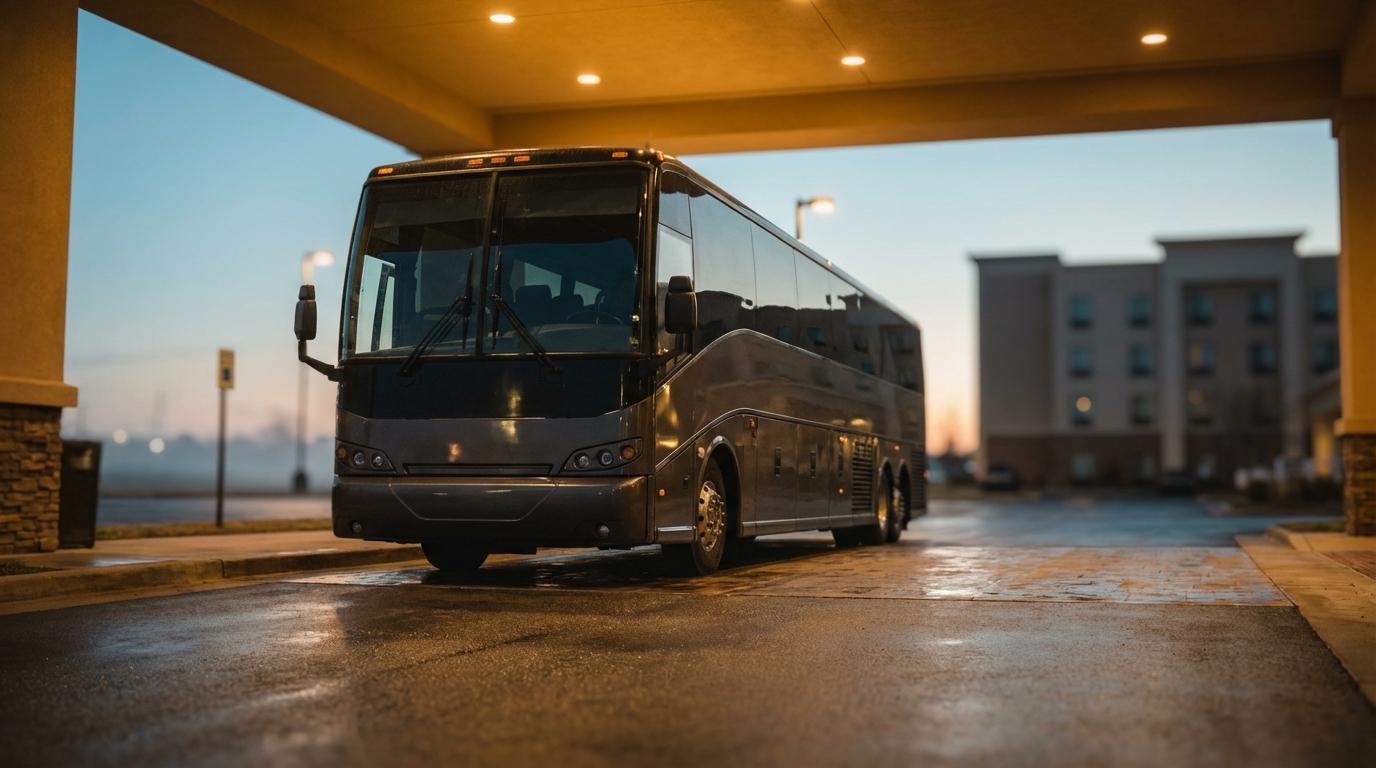
This past August I booked a charter coach for our team offsite, and the part I hadn’t planned for was the second pickup.
The coach collected most of us from the office car park at 7:10. I had confirmed that time with the operator twice (once by email, once on the phone, because I don’t trust a booking until a person has said it out loud to me). After the office it was meant to swing past the main train station for everyone who lives across the river, and my run sheet had a time for that stop as well. What my run sheet didn’t have was any way for the people waiting outside the station to know whether we were close. Not long after we pulled out, my phone started going. Priya wanted to know if we’d left yet, and when I didn’t answer fast enough she sent a photo of the taxi rank with a row of question marks under it. Tom just asked which entrance.
I was sitting right behind the driver with a clear view of the traffic, which did nothing for anyone standing on the station steps.
The office could see the coach
To be fair to the charter company, they knew where their coach was the whole time. Most operators of any size have GPS units fitted in their vehicles and someone in the office watching a map, and when I rang before the trip the woman on the booking line told me dispatch could give me the coach’s position whenever I called. That is a real service. It also means every question about the bus has to go through one phone line, and on a weekday morning that line is answering for every other coach on the road too.
Some operators go a step further and text the group contact a tracking link on the morning of the trip. Ours didn’t offer one, and I hadn’t asked (that one is on me, and it’s now on my booking checklist in bold).
What I ask before signing a booking now
If you’re the person organizing, there is one question worth putting to the operator before you pay a deposit: can the people at each pickup see the coach coming without having to phone anyone?
If they say yes, ask how it works. A link that opens in a browser is what you want. Plenty of people won’t install an app the night before for a single ride, and the ones who would are usually the same people who show up early anyway (guilty).
If they say dispatch can give updates by phone, ask who ends up calling whom. On my trip it would have gone like this: I ring dispatch, dispatch radios the driver, the driver gives a rough guess, and then I text Priya a number that’s already a few minutes out of date by the time she reads it.
If they say no, plan to share the location yourself from the bus.
That last option is what I ended up doing, standing in the aisle while we sat at a red light. I already had Konvoyage on my phone from a road trip earlier in the summer, so I tapped the plus button, picked Share my drive, typed the station into the “Where to?” box and hit Start sharing. Android’s share sheet popped up and I dropped the link into the offsite group chat. It went out as “Watch me drive live” with the link underneath, which made me laugh a little, since I was very much not the one driving. Nobody at the station had to download anything or make an account. The link opened straight in their browsers.
Priya sent me a screenshot a minute later so I could see what she was seeing. It was a map with a dot labelled Mel, a pin on the station, and “arrives 7:34” under it.
The texts stopped after that. Tom still didn’t know which entrance (the link can’t tell anyone that, and people watching it can’t send anything back through it), so I answered him in the group chat like a normal person. My phone went back in my jacket pocket with the screen off and kept updating. When the coach pulled up at the station the sharing ended by itself, because I had set the station as the destination, and I didn’t have to remember to switch anything off.
The clock time did the work
A dot creeping along a ring road tells you very little if you don’t know the road. What actually changed the mood on the station steps was a clock time, because “arrives 7:34” let people go back inside for a coffee and be out front again when it mattered. I’d take an honest arrival time over a nice map, and I really do like a nice map. It’s the same reason the “where are you” call dies down on road trips once everybody can see an arrival time, and forty people waiting for one coach works the same way, just with more phones.
When the pickup point moves
Stations close an entrance for works, and somebody will always message at the last minute to say they’re actually around the side. The live link won’t help with any of that on its own, because it shows where the coach is and nothing else.
My setup for any group pickup now has the link and a group chat running side by side. A changed meeting spot goes in the chat. When someone is running behind, they say so there and I work out with the driver whether we wait (I’d rather lose five minutes than leave someone on a pavement with a suitcase, but I also have a lodge booking that doesn’t care about my feelings). If it’s the coach that’s late, nobody has to ask, because the arrival time on the link has already moved.
The phone does need battery for all this. I keep an Anker power bank in my day bag for exactly this reason, and most coaches have a USB socket somewhere near the front seats if you ask the driver nicely.
If I ran a charter company
I know an organizer sharing her own phone from the aisle is a workaround. It worked, but it depended on me happening to have the app and happening to be on board for the leg before the pickup. If I ran a charter company, I’d want someone on the coach to start a live link when it leaves the yard and send it to the group contact, so the organizer just forwards it to whoever is waiting. That doesn’t need new hardware in the vehicle, only the driver’s phone, signed in, in its holder on the dash. Konvoyage has a business version for teams who need their people visible on a map, which is roughly how I’d pitch it to an operator. Dispatch would keep its map exactly as it is, and the people at the curb would get a link of their own.
Priya was on the station steps when we pulled in, holding a coffee. Her last text of the morning was another photo, this time of our coach turning into the station, taken through the café window about a minute before she walked out.