The moment your suitcase leaves the check-in scale, a printer behind the counter spits out a sticky tag, the agent loops it around the handle, and you get a stub with the same number. That number is the only thing the airport really knows about your bag. Everything that happens over the next few hours hangs off it.
Most of the time it works and you never think about it again. I got curious about the parts in between, which turned out to be stranger than I expected.
What the Barcode Actually Holds
Most people assume the barcode on a bag tag holds their flight and destination. It doesn’t. The barcode encodes a ten-digit number the industry calls the license plate, built from the airline’s numeric code and a serial number, and the airport code and flight number printed in big letters on the tag are there for the humans on the ramp. When a scanner reads your bag, it gets the license plate and then has to look up what that number means.
That lookup is the clever bit (and the part I went down a rabbit hole on). At check-in, the airline’s departure control system sends a small message, called a Baggage Source Message, to the airport’s baggage handling system, pairing the license plate with your flight and any connections. The sorting computer holds onto that pairing, so when the barcode reader at a belt junction sees the number, it already knows which chute the bag should drop into. If that message arrives late or never arrives, the bag is perfectly readable and still effectively unknown. It usually gets kicked out to a manual station where a person reads the printed tag and decides where it goes.
Barcodes have a physical weakness on top of that. A laser scanner needs to see the stripes, so a tag that’s crumpled, folded under a strap, smeared with something from the ramp or facing the wrong way on the belt can slide past unread, and every misread pushes a bag toward that same manual station.
Why Airlines Started Paying for RFID
RFID tags get around the line-of-sight problem entirely. A tiny chip and antenna are embedded in the paper tag, and a reader nearby powers it with radio energy and gets the license plate back without needing to see it, so a tag folded under a strap or turned the wrong way still reads. Nobody has to aim anything. Readers mounted over belts and on the belt loaders that feed the hold pick bags up as they roll past.
Delta spent 2016 putting RFID readers into its stations and chips into its tags, and it’s still the airline people point to. IATA has pushed its member airlines in the same direction, helped along by a rule that took effect in 2018 requiring airlines to track each bag at its main handoffs: when it’s accepted, when it’s loaded, when it’s transferred and when it’s delivered back to the passenger.
Not every airline has made that switch yet. Fitting every station with readers and paying extra for every tag adds up, and plenty of regional carriers and smaller airports still run on barcodes and handheld scanners.
The Part You Never See
A ramp operations supervisor at a mid-size U.S. airport once put it to me bluntly.
“People think their bag sits in the plane the whole flight and then slowly makes its way to them,” he said. “The chaos is all down here on the ground.”
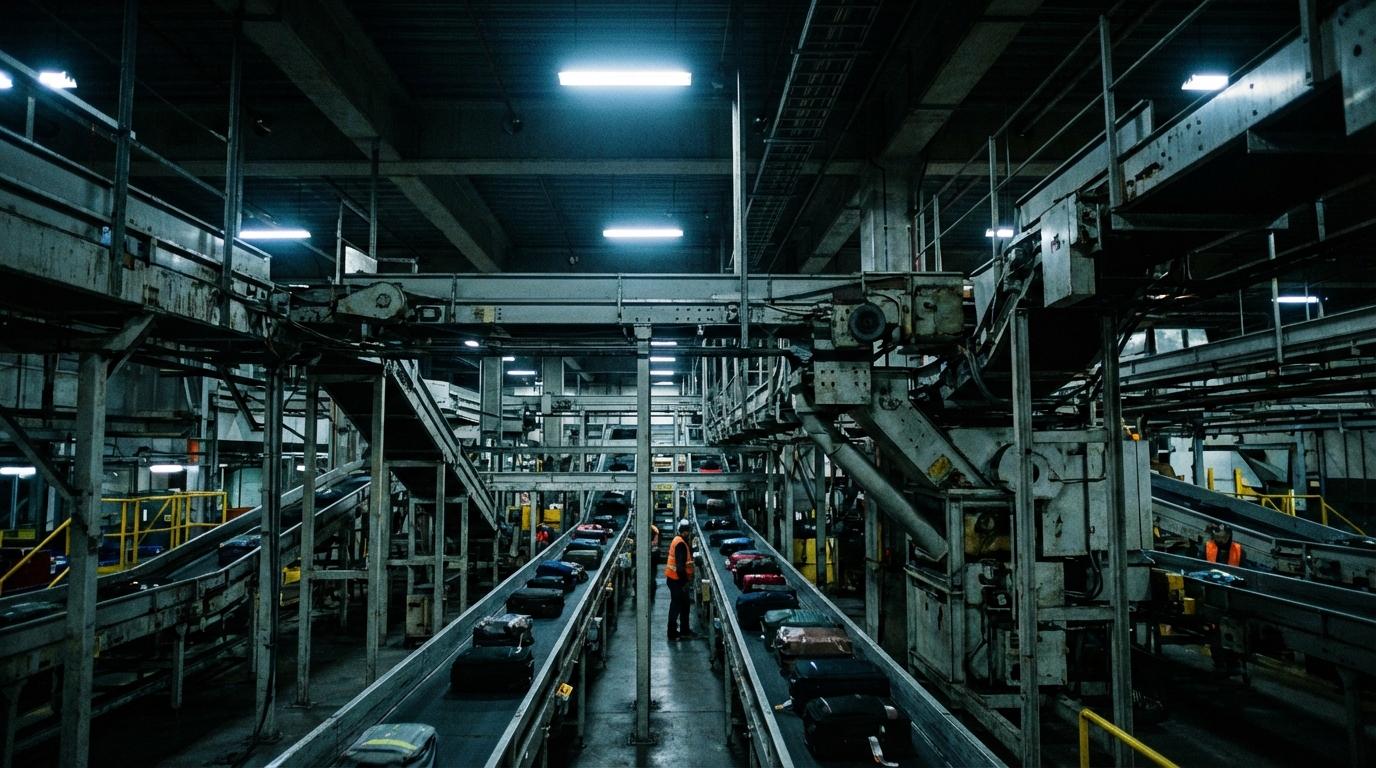
On arrival, bags come off the aircraft on a belt loader, get stacked onto carts and towed to the terminal, where someone feeds them onto the carousel. Connecting bags take a much harder route through the airport. Each one is pulled from the first aircraft, driven across the ramp, run back through the scanners and loaded onto a different plane, often with very little slack, while the crew juggles dozens of other flights.
Every one of those handoffs is supposed to produce a scan. With RFID, most of them happen on their own as the bag rolls under a reader. At a barcode airport, several depend on a ramp agent pointing a handheld scanner at each bag, and when a flight is late and the crew is short, those are the scans that get skipped.
Your bag may well be on the right plane. Nobody’s system can prove it, though, which is why an app sometimes shows a bag as unaccounted for when it’s sitting in the hold right under your seat.
What Your Airline App Is Really Showing
Most big airlines now push bag updates to their apps: checked in, loaded, transferred if you have a connection, arrived. None of those updates are GPS positions from the bag itself. Your airline has no idea your bag is near gate B14 in any live sense; it knows the license plate passed a particular reader at a particular time, and the app turns that into a status line. (If you’ve pictured a dot crawling across the ramp, the reality is closer to a parcel delivery page.) A phone reporting its position every few seconds, the way real-time ETA tracking works for people on the road, is a different kind of system altogether, and a paper tag with no battery can’t do that.
The delay between a scan and your notification varies a lot by airline. Some send it almost immediately while others batch updates, so if your app still says “loaded on aircraft” well after you’ve landed, the ground readers have probably already seen your bag and the notification just hasn’t caught up.
AirTags Aren’t GPS Either
Apple AirTags and Tile trackers gave nervous travelers a second opinion. Drop one in a checked bag and you can see roughly where it is on your phone, whatever the airline’s system says. During the holiday travel meltdown at the end of 2022, plenty of people posted screenshots of their bags sitting at an airport in a different state from the one the airline was claiming.
Neither of these trackers has GPS inside it, which surprises people. An AirTag sends out a Bluetooth signal, and any iPhone that passes close enough quietly reports its location to Apple, which passes it on to you; Tile works the same way through phones running its own app. In a busy terminal that means fresh positions every few minutes. A cargo shed at night, or a hold sitting at a quiet regional airport, can go silent for hours, and the last position you see might be well out of date.
Most airlines allow these trackers in checked luggage without any fuss, since the coin-cell batteries in them are tiny, though it’s worth checking your carrier’s rules before you fly. A tracker won’t stop your bag from being mishandled, but it gives you something concrete to show the baggage desk when you’re explaining that yes, your suitcase really is still in Denver.
I know all of this and I still fly without one. Last Thanksgiving my brother’s black roller went to Minneapolis instead of Phoenix with nothing but the airline tag on it, and it took days to come back while he wore my clothes. I haven’t bought a tracker for my own suitcase either.
Before You Hand Your Bag Over
Take a photo of the tag stub the agent gives you, because that license plate number is what the baggage desk asks for first. Pull any old tags off the handle before you check in so a scanner doesn’t read a stale one. A tracker is close to essential if your itinerary has multiple connections or an international leg, and probably not worth bothering with on a direct domestic flight. If the bag doesn’t show up, file the report at the airport before you leave and quote the tag number. Anyone with a tracker in the bag should show the agent where it says the bag is.
Put your name and phone number inside the bag too, since the outside tags are the first thing the belts tear off.