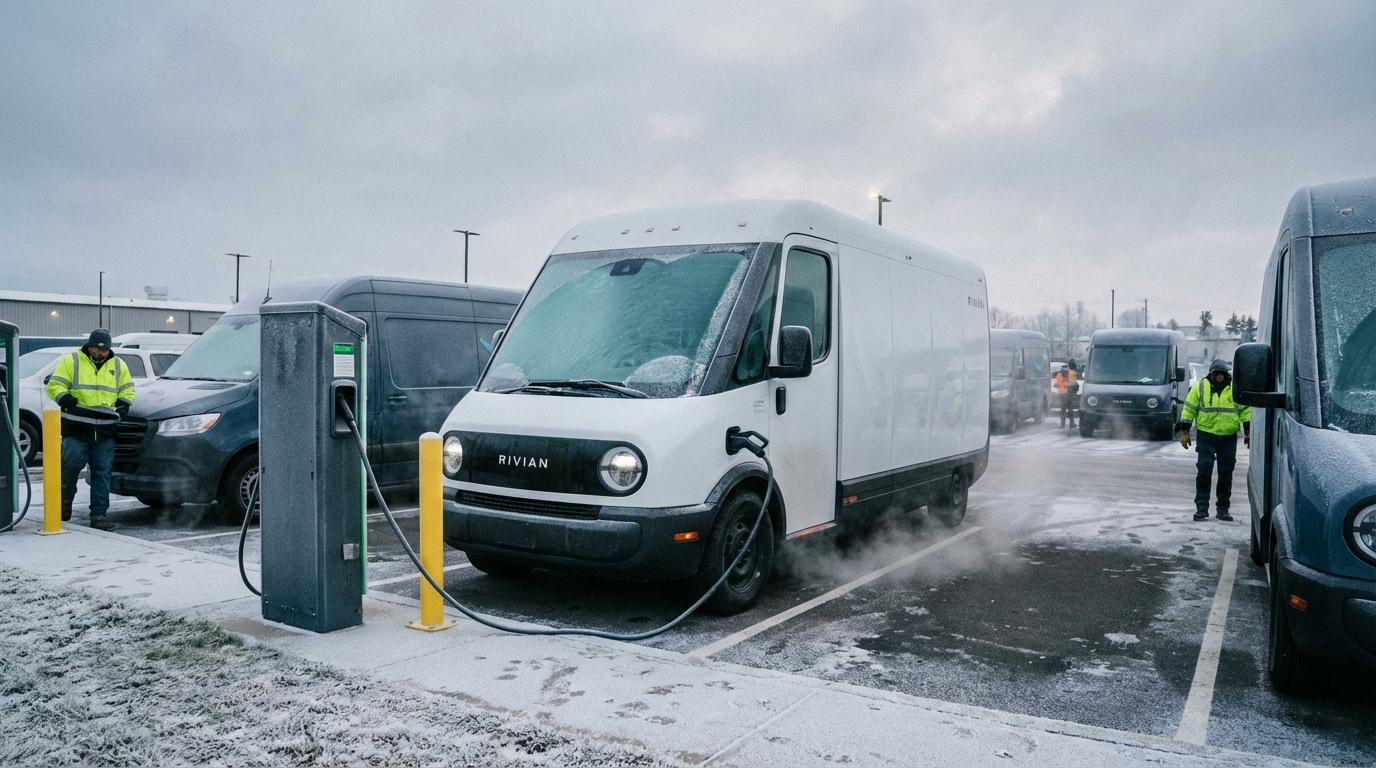
I once told a client their new electric delivery vans would barely notice winter. My deck was full of summer range data, and I presented it like it was settled. Then the first real cold snap came, and range across the fleet dropped by more than a third. My first response was a sprawling contingency plan with backup gas vans and rebuilt routes for everybody. It was far more than the problem needed, but I didn’t know that yet.
The range on the spec sheet for a Ford E-Transit or a Mercedes eSprinter was measured in mild weather. On a freezing morning you are driving a different van, and your planning has to account for that.
Why cold weather eats range
Lithium-ion batteries make power through chemical reactions, and cold slows those reactions down. Internal resistance goes up and the battery management system limits output to protect the cells. Software can soften this a little, and that’s about it.
Cabin heat makes it worse. A gas engine throws off waste heat that warms the cab at no extra cost. Your electric van has to pull every bit of that heat straight from the battery, and drivers on a delivery shift will run the heater hard because they keep opening the door to January air.
I learned this sitting in an E-Transit in Ohio on a 17-degree morning, watching the range estimate fall while the van sat parked with the heater on. It lost 12 miles before the first delivery.
I should have looked at winter data from fleets up north before that presentation. It was out there, and I didn’t check.
Precondition while the vans are still plugged in
Preconditioning timers solved most of the problem for that client. If the vans sit at a depot overnight on chargers, you can schedule the battery and cabin to warm up before the first route. That energy comes from the grid instead of the pack. The van rolls out with the battery already at a good working temperature, so the first stretch of range doesn’t go to warming up from cold.
Most commercial EVs can do this from the factory, and on the E-Transit fleets set departure times through Ford’s software. Vans without the feature can use aftermarket timers, though that is one more thing to maintain.
None of this works unless the vans are plugged in overnight. Vans parked at drivers’ homes or in lots with no chargers pay the heating cost out of the battery every morning.
Only some routes need to change
Start with the long ones. A summer route that already runs close to the van’s maximum range gets uncomfortable once winter takes a third off the top, and one detour or a bad traffic jam could strand the driver. You don’t have to redesign the whole network. Find the routes near the winter-adjusted limit and either shorten them or split them across two vans.
In practice, run your route planning with winter range instead of rated range. Some planning tools support seasonal range profiles, so turn those on if yours does. Otherwise, knock about 30% off your planning range from November through March and look at which routes go over.
I did this by hand one weekend with a spreadsheet and a thermos of coffee. It took four hours. Halfway through I got annoyed with myself, because the client’s routing software could probably have done it if anyone had known which setting to change. Nobody did, me included. The spreadsheet was ugly and slow, and it still told us exactly which routes were going to leave someone sitting on a shoulder waiting for a tow.
Regenerative braking also weakens in the cold. A cold battery accepts less charge back, so the stop-and-go gains you count on in city delivery shrink until the pack warms up. Put shorter stops early in the route so the battery is warm before the longer highway stretches.
Backup gas vans
Nobody wants to run two fleets side by side. Some operations still need a few gas or hybrid vans on hand for the coldest months, mostly for routes that can’t be shortened or split.
How many depends on where you drive. A fleet doing short urban routes can probably stay fully electric all year with preconditioning alone. Suburban and rural delivery zones are different, because routes there already stretch the van’s range and the coldest days push them over.
If you lease, ask about seasonal flexibility, since some leasing companies will add short-term gas vans for the coldest quarter. Owners can hold on to a couple of the old gas vans from before the conversion and park them until they’re needed.
What drivers can do about it
Drivers control more of the range than most managers expect. Hard starts from every stop cost some range, but idling with the heater running is the bigger winter waste. A short briefing can win some of it back. Heated seats help most. They use a small fraction of the energy that cabin heat does, so if your vans have them, ask drivers to use the seat heat and drop the cabin temperature a few degrees.
The plan I actually used
After that first rough December, the client went with much less than my big plan. We set preconditioning timers on every van that parked at the depot and cut back the two longest routes so they stayed well inside winter range. The driver briefing took a morning.
The contingency plan stayed in my drawer.
The first preconditioned van left the depot before dawn with a full charge and a warm cab. It finished a nine-hour route and came back with 23% left in the battery. January and February went by without a stranded van. The only gas loaner we used covered a day when a charger at the depot failed, and the driver complained about the loaner’s heater the whole shift.
Winter also makes it more important to know where your drivers are. When a van is low and a route is running long, the person at the depot needs to see where that driver is and when they’ll be back. If your team already shares location through a phone app like Konvoyage instead of another dashboard, you get each driver’s position and arrival time on one map, which helps on days when a route is cutting it close.
If you are getting ready for this winter, do the spreadsheet in October, before the first cold morning, and set preconditioning timers on every van that actually parks on a charger overnight. Ask your leasing company about gas loaners now too, before everyone else does.