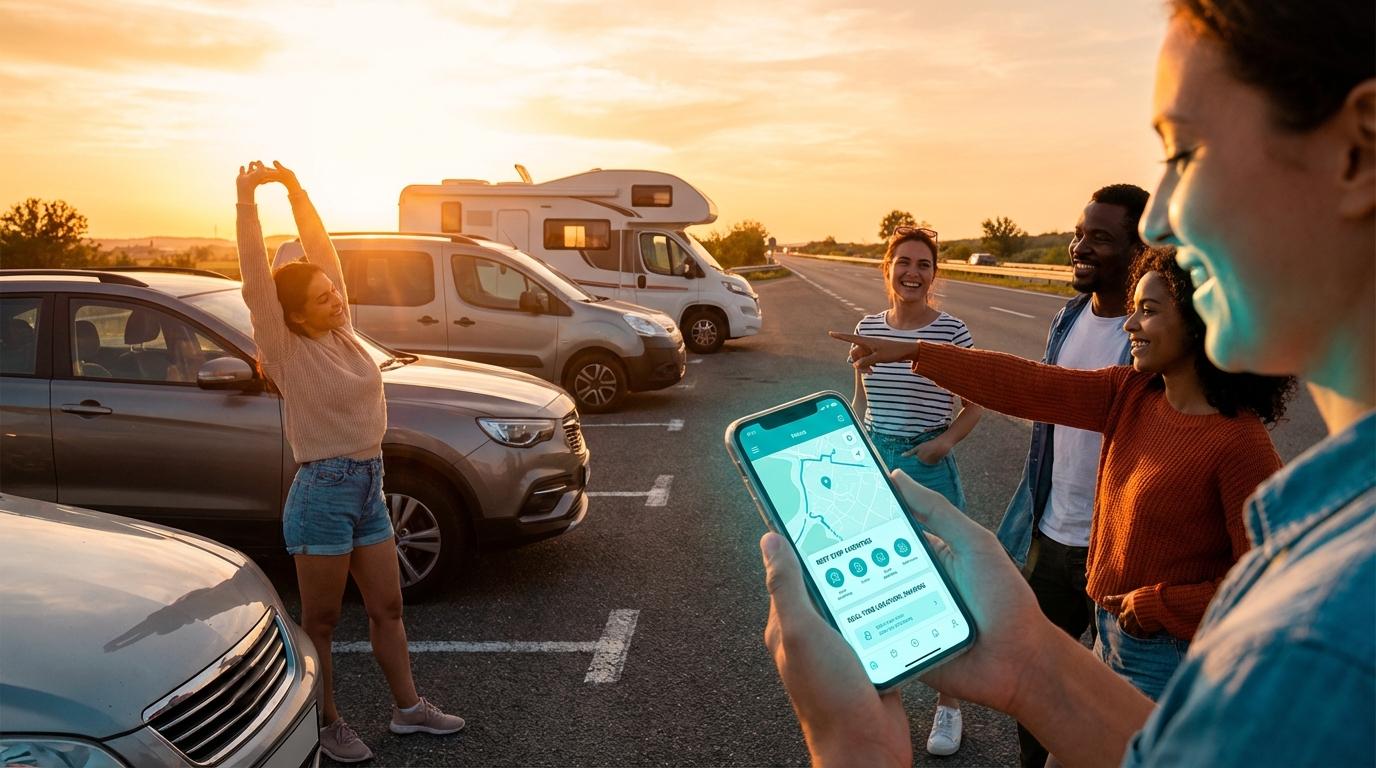
My cousin Marcus has a bladder made of titanium. The man can drink a large iced coffee at sunrise and not shift in his seat until we cross a state line, wearing a serene look, as if needing a restroom were something that happens to weaker people. Meanwhile I sit in the passenger seat doing quiet arithmetic about the last rest area sign and whether the next town on the map is really a town or just a church and a grain elevator.
I am also the person who says “I’m fine” when I am not fine. Someone asks if we need to stop, and my mouth says no while my body drafts a long letter of complaint, and by the time we pass the next exit sign I am gripping the door handle and squinting at the horizon for anything that might have plumbing. I have never fixed this about myself, and I am rarely the only one in the car doing it.
Put five people across a few cars and that private bargaining becomes everyone’s business, because nobody’s body runs on the same clock, and the gap between “we just stopped” and “I need to stop again” can sour a whole day if no one says it out loud. What I’ve landed on is unexciting and it works: decide where you’re stopping before anyone has to ask.
Every group has a Marcus
Marcus treats pulling over like losing an argument with himself, and when someone in the back timidly asks to stop he says nothing, which is somehow louder than saying something. He isn’t superhuman, and half the time he has barely drunk anything since breakfast, which is its own kind of reckless on a hot day. I once watched him walk out of a Love’s restroom in Oklahoma after a very long stretch of insisting he was fine, and the look on his face was so peaceful I almost took a photo. To this day he denies it ever happened, loudly, whenever my sister brings it up.
The trouble with a Marcus is that he quietly sets the standard for everyone else. If he can hold it, the reasoning goes, so can you, except bodies don’t work that way. Medication, pregnancy, an anxious stomach and the size of your morning coffee all change how long someone can comfortably sit, and none of it should need explaining over a walkie-talkie at highway speed.
What I do before we leave the driveway
After enough trips where somebody ended up miserable and too polite to say so, I started putting the stops into the plan before anyone got in a car. They go in as plain facts, the way you’d write down a departure time: we get off at this exit, at roughly this point in the morning, and nobody had to ask for it.
The tricky part is finding the right rhythm for your particular group, and the only way I’ve found is to ask in a way that gets a real answer instead of everyone claiming to be flexible. I send the group chat something like, Be honest: what’s the longest you’re comfortable going between bathroom stops? No wrong answers, I’m planning around the shortest one. Saying I’m planning around the shortest one up front means the person who needs stops most often sets the pace without having to argue for it, and the rest of us quietly benefit.
With that interval in hand, I open the route and start marking exits, though only the ones with something real at the bottom of the ramp, like a gas station with an actual building attached or a rest area that stays open all winter.
I call the first stop before anyone thinks they need it, usually somewhere past the edge of the suburbs where the coffee from home has started to make itself known. Bathrooms are only part of the reason, and maybe not even the main one. The person who forgot a phone charger finally mentions it while somebody else buys the bag of sour gummy worms that will be gone by noon. Then everyone uses the restroom anyway, and the whole group ends up on roughly the same internal clock. After that reset the gaps between stops stretch out on their own, because you’re no longer juggling separate bodies on separate schedules.
The stops after that I space unevenly on purpose, closer together before a stretch where I know there’s nothing for ages and further apart where the exits are thick enough that we can skip one if everyone feels good.
The Thanksgiving convoy
Last Thanksgiving our convoy down to my aunt’s place in Texas was my niece, my uncle with a bad hip, my sister who was five months pregnant, Marcus, and me, and this was before I planned any stops, so we left that morning with no plan beyond pulling over whenever somebody asked. My niece announces bathroom emergencies at full volume with almost no warning, the way kids do. As for my uncle, he doesn’t need to stop more often than anyone else, but he needs time to get out of the car slowly and a restroom he can reach without stairs or a dark gravel lot. Even once I started planning, I only ever thought about how often we stop, and nobody asked him what he needed.
My sister needed stops at intervals that would have made Marcus weep, and she felt awful about it. Every time she asked to pull over there was an apology already in her voice, as if she were wrecking everyone’s day by having a body that was busy growing a person. She wasn’t wrecking anything, but I could hear how much it cost her to ask. Somewhere around lunch I sat in a parking lot and marked stops on the map at the interval she needed, and after that she stopped being the reason we pulled over. When we got off at the Buc-ee’s outside Temple, she walked into the restroom without thanking anyone.
Kids change the math
If one car has small children and the others don’t, let that car leave earlier. They’ll stop more often and move slower through the mess of dropped crackers and a car seat buckle somebody undid, and they’ll still roll in close behind everyone else. Trying to hold a toddler to the same stop schedule as a car full of hungry college friends ends in a breakdown, and not the mechanical kind.
Scouting stops you won’t regret
Not every rest stop deserves the name, and if you’ve ever pulled into a gravel lot with a single porta-potty baking in the August sun, you already know the smell I mean, that thick chemical sweetness that reaches you before you’ve even opened the door. I’ll drive a long way past one of those, and I’m not ashamed of it.
State-run rest areas are the safe choice, with real restrooms, running water and often a patch of grass and a picnic table where kids can run off some of the car. They also tend not to surprise you with a handwritten Out of Order sign taped to the only stall.
Truck stops are the ones people underrate, and I used to be one of them. They’re built for volume, so the restrooms are usually cleaner than the average gas station where the key hangs off a hubcap, and most of them have a food court, which means your quick bathroom break can quietly turn into lunch. The lots are huge, which matters when you’re gathering a convoy back together. Nothing tests a group like several cars circling a tiny gas station lot while someone inside stands frozen in front of the jerky rack.
The places I skip are seasonal rest areas I haven’t confirmed are open and stops you can only reach from the other side of the highway, which you tend to discover after you’ve passed the entrance. I also skip anywhere the reviews mention an animal living in the restroom, because I have read those reviews and I believe every word.
When someone needs a stop that isn’t on the plan
It will happen, and the only right answer is copy, taking the next exit.
Nobody sighs over the radio or mentions that we stopped not long ago. Planning the stops ahead was supposed to make stopping feel ordinary, and an extra one doesn’t undo that, but a sarcastic comment can. The person on the receiving end won’t ask again, and you’re right back to white knuckles on door handles and people lying about being fine. If the reason is medical, like someone who needs medication that’s packed in another car, you will want to regroup fast. In our convoy a passenger usually taps the “Wait for me” message in Konvoyage so the other cars see it without any driver touching a phone, and whoever is ahead takes the next exit and waits.
Some parts of the country simply run out of exits. West Texas does it, and so does the highway across Nevada they call the Loneliest Road, where the next town is more of a rumor than a place. Before we enter a stretch like that I stop whether or not anyone needs it and tell everyone that the next chance is a long way off, because the worst version of this trip is a small voice from the back seat asking to stop when there is truly nowhere to stop. The gas gets topped off and the dog gets a slow walk along the scrub at the edge of the lot, warm dust settling on everyone’s shoes.
Those empty stretches are also where audiobooks beat music for me, because once the landscape flattens out and the road starts to hypnotize you, a good story keeps the whole car awake in a way a playlist never quite manages.
The drive home
On the Sunday drive home, a little north of Waco, my niece came over the radio from Marcus’s car to announce that Marcus needed to stop at West. It wasn’t on my list.
We pulled into the Czech Stop, where the line for kolaches ran almost to the door, and Marcus walked past all of us to the restroom without making eye contact, then came back out a few minutes later carrying a paper bag of pastries he did not offer to share. Nobody said a word about it on the radio, though my sister smiled the whole way back to her car. I’d like to tell you I’ve stopped pretending I’m fine, but on the next stretch north I let a couple of exits slide by before I admitted I needed one too.