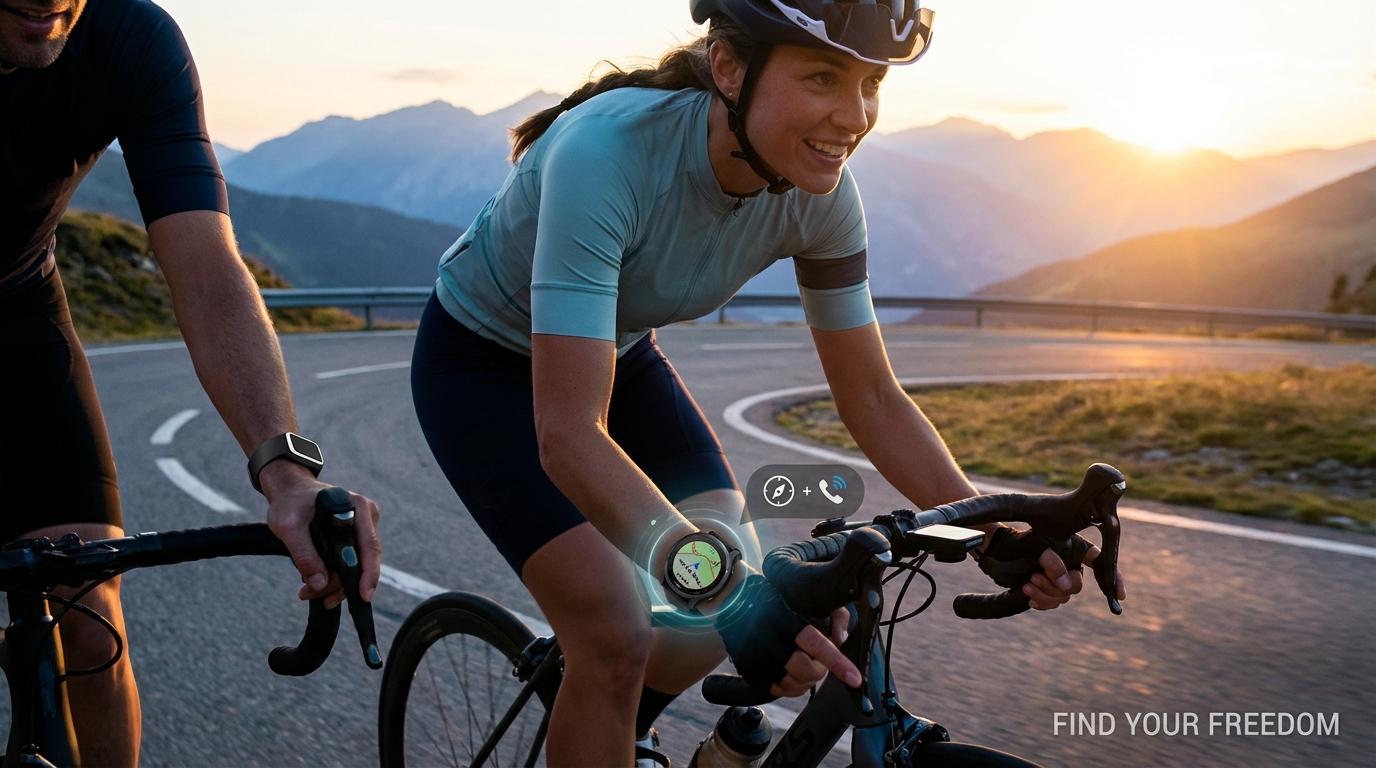
My fitness band has never once known where I was. It knows my heart rate and roughly how badly I slept, and that’s about it. A cellular watch, the kind with its own eSIM, can put a pin on a friend’s map while the phone sits at home on the kitchen counter.
I noticed the gap at a music festival last summer. All of us had our phones sharing location, and we could find each other across a huge crowd in a few minutes. The wristband the festival gave us did nothing of the sort. It was a strip of fabric with an NFC chip for buying overpriced lemonade. Meanwhile I had a band on my other wrist that, I realized halfway through the weekend, was just as clueless about where I was standing.
That got me reading spec sheets, which is how I lose most evenings.
What’s actually inside a cellular watch
A cellular watch from Apple or Samsung is a small independent computer. It has a satellite receiver that uses several satellite systems, not just the American GPS one. Next to it sits a cellular modem with its own eSIM, so it can reach a cell tower without borrowing your phone’s connection. The watch works out where you are, then pushes that over the cell network to a server your friends’ phones can read.
A fitness band has neither part.
Most bands skip GPS completely. Some newer ones include a GPS receiver but still have no modem, so they can record where you went and tell nobody while it’s happening. Everything goes through your phone over Bluetooth, and Bluetooth gives up at around ten meters once there’s a wall or a bag in the way. Leave the phone in the car and the band goes quiet.
The map that isn’t the band’s
Some bands pull a trick that fooled me for months. You finish a run, open the app, and there’s your route drawn neatly on a map. The band didn’t draw it. Your phone was in your pocket recording the whole time, and the app matched the two up afterward. Run without the phone and that map is blank.
Battery, mostly
Bands skip the radios to save battery.
A GPS chip draws a lot of power, especially when it’s first searching for satellites. The cellular modem is worse, because it has to keep talking to a tower and sending data. Without either, a band can go two weeks between charges. Add both and you’re charging every night, sometimes sooner if location is streaming all day. Manufacturers picked a side: bands are for people who want to put something on and forget it, and cellular watches are for people who want a small phone on their wrist.
I still haven’t found a watch I trust to get through a long day out and the drive home with location sharing on the whole time. The ones my friends wear are begging for a charger by mid-afternoon.
Side note: I once spent an afternoon reading the FCC filing for a fitness band because the company advertised “connected GPS” and I wanted to know what that meant. It meant Bluetooth to your phone. The band had no satellite receiver at all, and the phrase was picked so you wouldn’t notice. I still get annoyed thinking about it.
Where it starts to matter
On a solo jog around the block, none of this matters. Nobody needs you on a map. It starts to matter once other people are involved and somebody needs to know where somebody else is.
Take a group bike ride where one person drops off the back on a climb and nobody notices for ten minutes. If that rider has a band and left the phone in the car, there’s no dot for them anywhere. With the phone in a jersey pocket, the dot shows up, but only because of the phone. It’s a slower version of what happens when a convoy gets split by a red light: the people in front keep going and assume everyone is right behind them.
The safety side is less funny. Say someone gets separated and their phone died an hour ago. A band can’t share their position or call anyone. The cellular watch can, with no phone nearby, as long as it still has a cell signal, and that’s the real reason I’d pay for the cellular model if I spent much time in the backcountry. I don’t, so I haven’t.
GPS bands: halfway there
The middle option is a band with built-in GPS and no modem. These record an accurate route during a workout without the phone, and afterward you get pace and elevation on a decent map. For looking back at your own run, it’s good.
During the run, though, nobody else can see you. The band stores the track and syncs it later, so your friend gets a nice map of where you were earlier. My sister wore one on a group hike in the spring and spent that evening proudly showing everyone a perfect route of the forty minutes she’d spent on the wrong trail, while we stood at a junction shouting her name.
What I actually tell people
If your phone is always on you, the band is fine. The phone does the location and the data connection, and the band adds heart rate and sleep on top. That covers most people most of the time, and there’s no point paying for cellular you won’t use.
If you want to leave the phone behind, or want a backup for when it dies, you need a watch with its own connection, which for most people means a cellular model. The battery cost is real.
On our road trips the wearables don’t come into it at all. Each driver’s phone is mounted on the dash and plugged in, and the phones run the live map. Use something like an app that works across both iPhone and Android so nobody gets left off the map because of their device choice. Last summer the guy with the 30-dollar band and the woman with the 400-dollar watch showed up on the same map, because neither of those devices was doing the work.
I still wear the band. This morning it told me I slept badly, which I already knew, and it has no idea I’m writing this from a gas station parking lot.