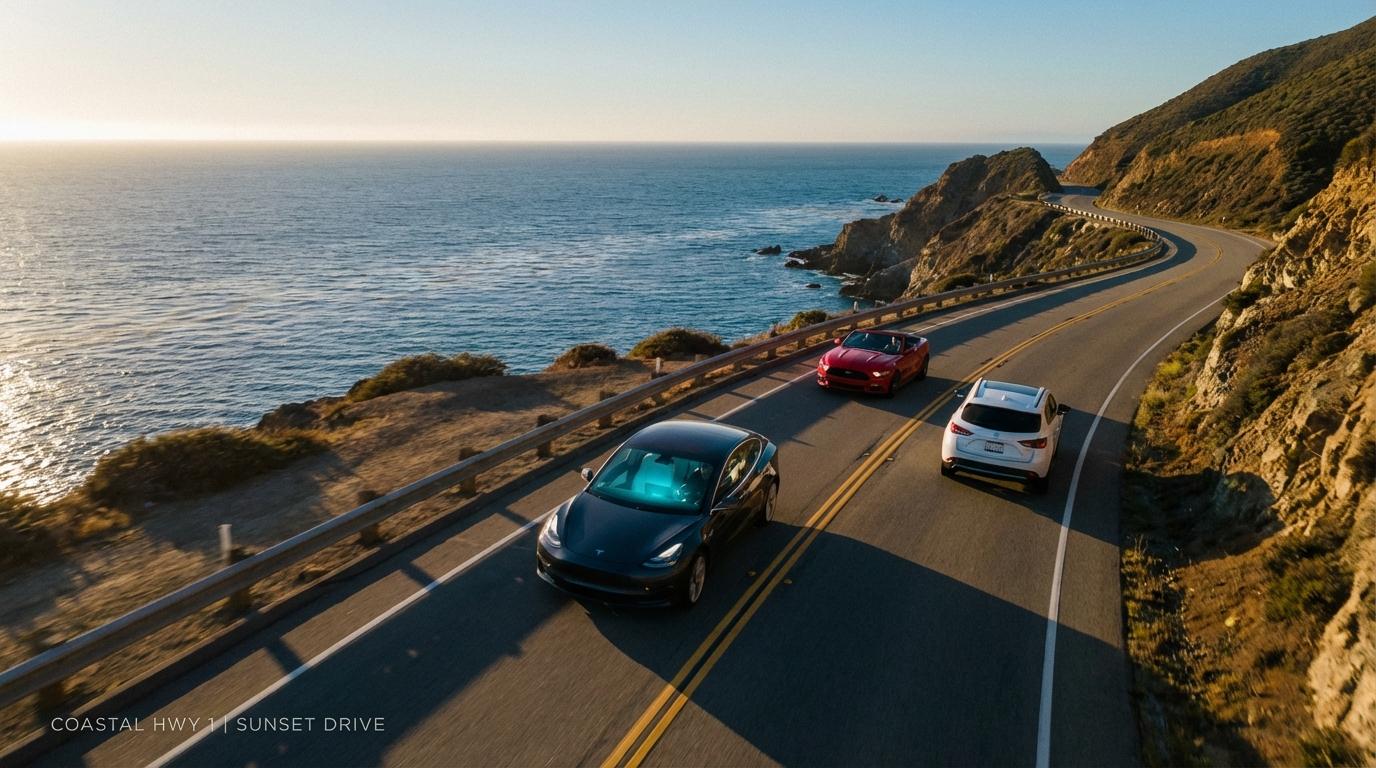
Because only one car in a convoy is really navigating, everyone behind it slowly stops paying attention to the route, and I am the worst offender I know. When someone else is in front, my brain files the drive under passenger activities even though my hands are on the wheel. On a back road in northern Arizona I once missed a turn the lead car made right in front of me, because I was watching a hawk circle over a field, and I only noticed when the silver Honda I was supposed to be following was no longer anywhere in my windshield.
Put me in front and the opposite happens. I read every sign and I’m already thinking about the next turn while the current one is still coming up.
That difference between how people drive in front and how they drive behind is what most convoy advice skips when it asks whether the lead car should navigate or simply set the pace while someone else calls the route. I’ve changed my mind on this more than once, and where I’ve landed has less to do with who knows the roads and more to do with whose attention gets better when there’s more to handle.
What the lead driver is actually doing
Leading means running a loop that never quite stops: mirror, windshield, upcoming signs, mirror again, with a constant background check on whether the cars behind are still there. None of it is hard on its own. What wears you down is that small choices, like which lane to sit in before a split or how early to signal, are being made for several cars at once, and a wrong one costs the whole group a U-turn instead of just you.
Yellow lights show this best. If the convoy is strung out and the light changes, the lead driver has to accept that the back half will probably be stopped at the red, and the right move is to let that happen and ease off until they catch up rather than push through and hope everyone else does too. Lane closures work the same way, where signaling and merging early gives the people behind you time to copy you before the gap closes. After a few hours of this kind of thing, the lead driver is noticeably slower to react than they were at breakfast, even if they insist they feel fine.
Why the front is still the best seat
The reward is that you see the road before anyone else does. Leading through a mountain pass early in the morning, with nothing between your windshield and the next curve, you set the pace from what you can see instead of from someone else’s brake lights, which turns out to be a calmer way to drive than it sounds. If the weather turns partway through, the question of who should be in front gets more complicated in snow.
Following is easier, and that’s the problem
Following feels relaxing because the car ahead does your navigating for you. You turn when they turn and brake when they brake, and the directions on your own screen become something you stop reading. I have driven long highway stretches in a convoy and could not have told you afterward which towns we passed, because I wasn’t keeping track of where we were, only where the car in front was.
There’s a reason following wears attention down, and it comes from the kind of task it is. Traffic engineers describe car following as a control loop: you watch the gap and the closing speed to the car ahead and adjust your pedals to keep both steady, with no need to know where the road goes next. Each driver in that loop responds a little late (reaction times of around a second are normal, and that’s for someone who is paying attention) and tends to overcorrect, so a gentle brake by the lead car becomes a firmer brake further back and something close to a hard stop at the tail. Researchers call this string instability, and it’s the same mechanism behind those highway slowdowns that appear for no visible reason and then dissolve. For a convoy, the useful part is that followers are doing a reactive job that rewards staring at brake lights and does nothing to keep them oriented, which is the opposite of what you want from someone who might have to take over the route at the next stop.
My friend Marcus reacts to following in a completely different way from me. He finds it stressful to respond to taillights without knowing why they lit up, and while we were swapping positions at a gas station outside Flagstaff he told me he would “rather be stressed and in control than relaxed and blind.” He’d spent most of the morning in the middle of the line and still looked tense standing at the pump. Once he moved to the front his shoulders came down, and he drove the rest of the day there without complaint.
I would have felt the reverse, which is why I no longer think the choice of lead driver comes down to route knowledge or radio gear alone.
Putting your best navigator at the back
There’s a third arrangement that casual convoys rarely try, where the lead car drives and sets the pace but the person managing the group rides in the last car. It struck me as backwards the first time a friend suggested it, until I thought about what the tail car can actually see. From the back you watch gaps opening up and cars getting stuck at lights as it happens, while the lead driver has to piece that together from mirrors.
The tail car’s job is to notice problems and tell the front. When it works, someone in the last car says something like “blue Subaru missed the exit, take the next one and pull into the rest area,” and it reaches the lead car before the lead driver realizes anything has gone wrong. This needs a passenger in the tail car handling the radio or group call, because the person driving the last car should be driving. Unlike the lead car, the tail can’t show anyone what to do by example, so every instruction has to be spoken, often over road noise and somebody’s kid in the background of the call. It also only helps if everyone actually keeps the channel open.
Splitting the job
The setup I’ve had the most luck with uses both ends. Up front, the lead car handles the driving and signals turns early, and the tail car watches the group and makes the calls about stops and regrouping, while whoever is in the middle just has to stay between them. It needs two people willing to stay focused for the whole drive, but on a long day it spreads out a load that would otherwise sit entirely on the lead driver.
Swap at fuel stops
Rotating the lead at fuel stops is the habit I’d push hardest, mostly because of fatigue. The lead driver has been making decisions nonstop since departure and is usually the last person to notice their attention narrowing, so the swap should happen on a routine rather than when someone admits they’re tired. My version is simple: the current lead fuels up last and drops to the back, and everyone else moves up a spot. Since you’re already parked anyway, the swap costs nothing extra.
Before anyone pulls out, the new lead should have the destination loaded in their own navigation, since a rotation that begins with “wait, where are we going?” just moves the confusion to the front of the line.
Where live location changes the question
After a lot of convoy driving, I’ve come around to thinking that who leads matters less once everyone can see everyone else. With real-time location sharing, each car has a map with the whole group on it, so the lead doesn’t have to guess whether the group is still together, and a car that falls behind shows up as a dot drifting away from the others instead of as a sudden silence on the radio. If you’ve ever wanted to stop the constant “where are you” calls, this is the part that does it, as long as a passenger is the one checking the map.
Konvoyage also takes over part of the tail car’s job on its own. It keeps checking the group’s positions and sends the whole trip an alert when someone is falling more than 10 km behind or when a car has stopped for a while. That 10 km is measured in a straight line (not along the road), so on a winding mountain route a car can be farther back by road than the alert suggests. For anything complicated I’d still keep a person at the back with a radio. On an ordinary highway day, though, the alerts cover a good share of what the tail car used to call ahead about, and nobody has to keep counting cars in the mirror.
Who I’d put in front
My answer is the person whose attention gets sharper under pressure, which isn’t always whoever knows the route best or has the most years behind the wheel. Marcus clearly belongs there. I do too, which I don’t enjoy, but the version of me that leads is watching the road and the version that follows is watching hawks, so I’ve stopped volunteering for the middle of the line and our drives have gone better since.
If you’ve been taking the easy spot in the middle because it’s relaxing, how much of your last convoy trip do you actually remember?