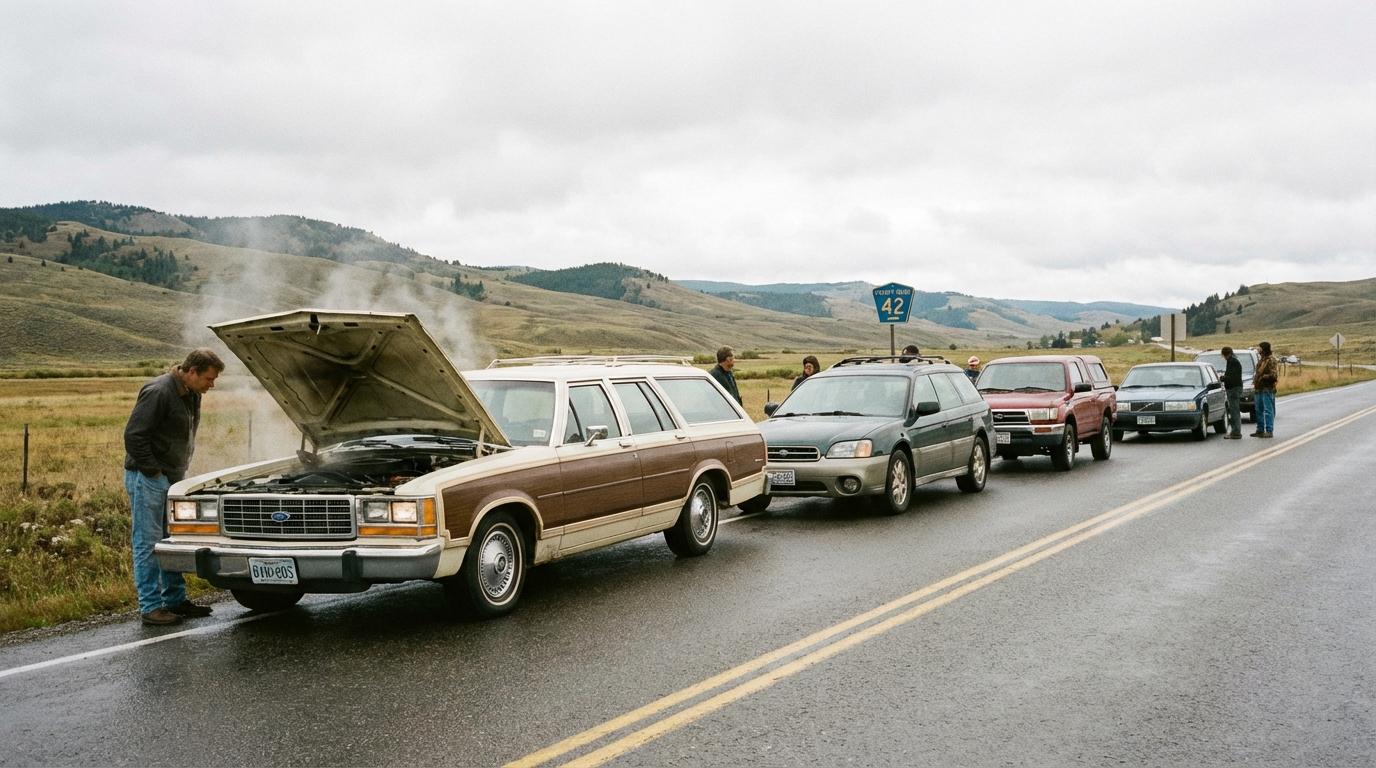
The worst car should never lead. I learned that running deliveries in a white Ford E-350 with a radiator leak our shop kept patching instead of fixing. One summer afternoon dispatch put that van on a hill route, and it overheated climbing out of a valley on Route 9. It quit in the right lane and sat there for over an hour while traffic squeezed around it and we waited on a tow.
Dispatch pulled it off hill routes after that. It spent the rest of its life on flat suburban loops, where the leak still dripped but nobody else paid for it.
Friends on a road trip make the same call dispatch made, usually without noticing they made it. Someone with a tired car ends up in front because they know the way, or because they pulled out of the driveway first. Nobody brings it up, since saying “your car is the sketchy one” out loud feels rude. The car most likely to fail ends up in the spot where a failure hurts the most.
You already know which car it is
By worst I don’t mean the oldest car or the one with the most dents. I mean the one most likely to have a problem on this particular drive. That might be a check engine light that has been on for weeks, tires that are legal but get nervous in the rain, or a battery that needed a jump recently. A dark oil spot in the driveway every morning counts too.
Everyone in the group can usually point to it without thinking.
I am bad at checking this myself. Before a trip I will sort out meeting points and fuel stops, and then never ask whether anyone’s car has a problem. I plan the trip and assume the cars will show up fine. That gap has bitten me more than once, and I suspect I’m not the only organizer who skips it.
A stall at the front stops everyone behind it
Whoever leads sets the route and the speed for every car behind them. If the lead car stops on a single-lane road, the convoy stops with it. There is no going around.
On a two-lane highway it gets messier. The car right behind the leader might pull over next to it, while the next one passes and then hunts for a shoulder further up. At the tail, the last car might not even see what happened and keep going. Within a couple of minutes the group is spread across several pullouts, and somebody is calling a friend who is also behind the wheel.
There is also the route to think about. If the lead driver was the only one who knew where the campground turnoff was, that driver is now standing on the shoulder next to an open hood. Everyone else is following a destination pin they never looked at closely, on a road where they were counting on taillights to tell them when to turn.
A breakdown at the back is a much smaller problem. The cars ahead keep moving until they find a safe place to pull off, then wait or turn around. Someone who knows the way is still in front.
The middle is workable too. Cars ahead of the stalled one get to a safe spot, and the car behind is right there with it. You end up with two small groups instead of one stalled line, and each can handle its own part.
In warehouse work we would never put the least reliable machine at the start of a line, because when it goes down everything after it waits. A convoy works the same way. That E-350 was not more broken on Route 9 than it was in the suburbs, and the radiator leaked the same amount on both. What changed was where it quit. On the hill route it stopped in a live lane and held up everyone behind it, while a breakdown on the flat loops would have meant rolling onto a side street and calling the shop.
The speed problem nobody mentions
Even without a breakdown, a weak car in front causes trouble, because people match the taillights ahead of them. It doesn’t matter that everyone has navigation running. The lead car sets the pace.
A driver leading in a car they don’t trust usually does one of two things. Some push the car harder than they should so the group isn’t held up. Others baby it, and the whole line crawls along behind them while people get irritated.
I rode along once with a guy whose car had a transmission that slipped between gears. He was leading a group of four cars to a lake house. Nobody told him to hurry, and nobody honked, but he kept checking the mirror and kept his foot down. When the shift got rough on a long grade he said “it does that” and kept going. On his own he would have pulled into the next gas station and let it cool off. With three cars behind him he didn’t want to be the reason everyone was late.
We made it, barely, and he spent the weekend looking up transmission shops.
The slow version breaks a group up in a different way. People behind get bored and start passing, and soon the convoy is scattered across the highway with everyone driving their own trip. The cars behind also can’t see what the lead driver can feel. From back there the taillights look normal and the speed looks steady, so the rest of the group finds out about the problem when the hazards come on.
When the slowest car can lead
Slow and unreliable are different things. A car that is comfortable at 60 mph but starts every morning and runs clean can lead just fine, as long as the group agrees on that speed before leaving. I’d take a slow car that always starts over a quick one with a warning light on. If everyone knows you are cruising at Sarah’s pace, nobody is surprised by it.
Winter is where car order matters most. The car with the best tires should lead and set a speed that suits the road, with a confident driver at the back and the car with questionable tires in the middle. That way the car in trouble has someone behind it who will see it slide, and an app that sends automatic alerts when someone stops or falls behind can let the cars ahead know without anyone typing a message.
How to say it without insulting anyone
Nobody wants to tell a friend their car is unreliable and should go to the back, so I give a practical reason instead. “The car with the biggest tank leads so we stop less” works, and it is usually true. So does “whoever knows the road best leads.”
A shared live map takes some pressure off the lead car, because it no longer has to be the navigator. If somebody pulls over, everyone can see where, and regrouping goes a lot faster when nobody is guessing. It doesn’t change who should be in front, though. You still want the car you trust most setting the pace.
Before leaving, I’d run a five-minute check on every car. It isn’t an inspection, just a way to spot the obvious risk:
- Any warning lights on the dash?
- When was the last oil change? If nobody remembers, that tells you something.
- How do the tires look, and has anyone checked the pressure?
- Has it needed a jump start or started making a new noise lately?
The goal is to find the one you don’t want in front and put it in the middle, with cars ahead and behind. On a long stretch the group might spread out over many miles, and when you zoom the map out to find everyone, small dots can get hard to see. A car sitting in the middle of the group is much easier to keep track of than one that broke down out front with nobody ahead of it.
Most groups never discuss car order. They leave in whatever order people back out of the driveway, and that works until one car isn’t up to it.
Our shop never did replace that radiator on the E-350. They just stopped sending it up hills, and it kept running those flat loops for years. I’d do the same with the tired car in your group: put it in the middle and let a car you trust set the pace.