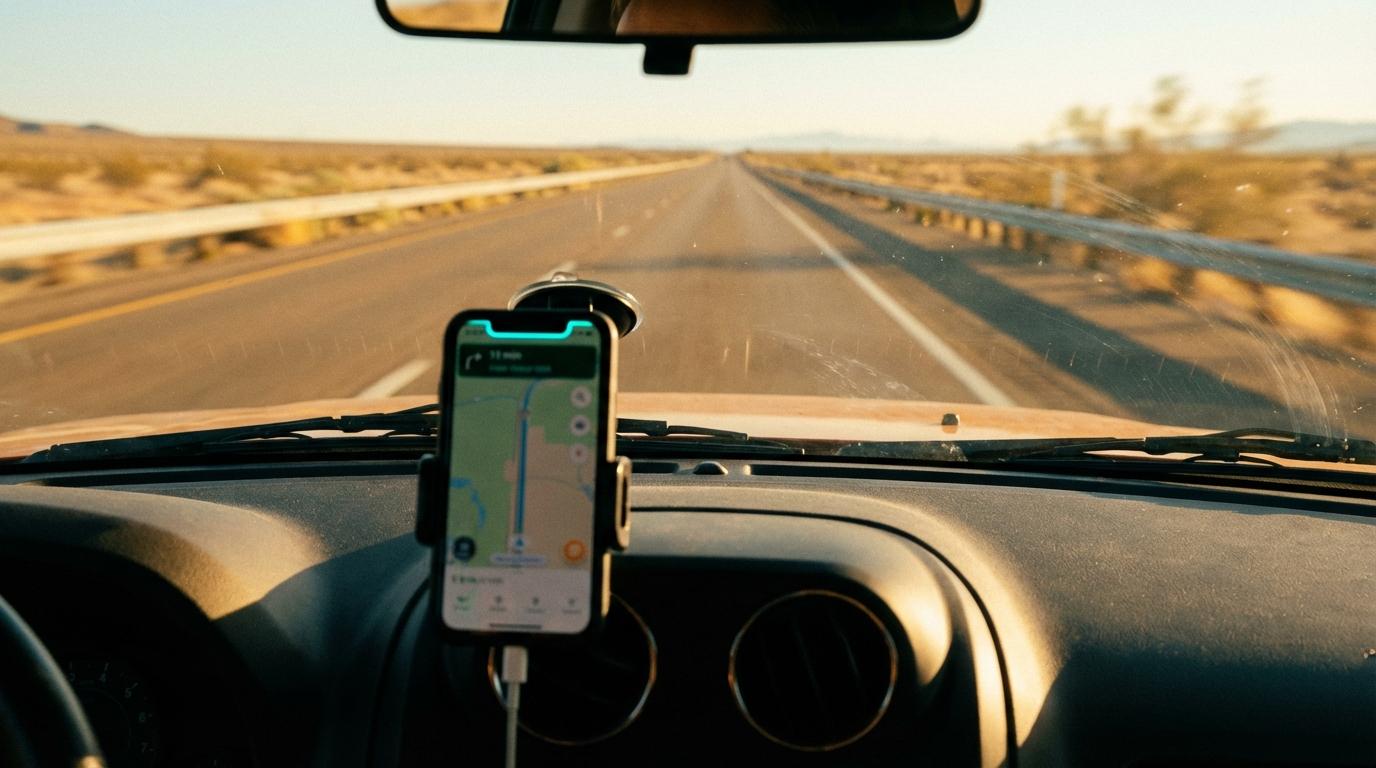
My first convoy alert made no sound. We had a few cars on I-40 west of Amarillo, I was in the lead doing about 70, and the pavement had that sun-softened texture where the tires sound sticky. The radio was low enough that I could hear wind pushing against the mirrors.
A rounded cyan box popped up a little below the top of the map on my dash-mounted phone. It had Priya’s name in bold, then “is falling behind” and the gap, which had just passed 6 miles. I read it like a mileage sign and lifted off the gas.
Closer to a road sign
A text buzzes and then sits there waiting for an answer, and at highway speed that pull toward the phone is the part that gets people hurt. With the map open on screen, the falling-behind alert in Konvoyage makes no sound and doesn’t vibrate. If the app is in the background, it comes in as a normal phone notification instead, which is one more reason I keep the map up while driving. It stays on the map for 8 seconds, then shrinks and fades out. You can tap it to clear it sooner, but I never once did that while moving.
What the colors mean
Before I read a word, the color already tells me how much to care. Cyan covers the routine stuff: someone falling behind, someone who has stopped, someone moving again, someone who arrived. Orange shows up when a driver may be off route, and also when somebody taps one of the quick messages like Wait for me or Go ahead. Red is kept for a police report from someone in the group and for the box saying a driver may have separated from the rest. That last one only comes when the gap gets to roughly 30 miles, and it stays up longer than the others. Chat messages arrive in gray, and I mostly ignore them until we stop.
Police reports get a second layer. When you get close to the spot someone reported, a separate POLICE AHEAD banner slides down from the top with the distance on it, and the phone vibrates. I’m fine with that one buzzing.
Why it goes away on its own
If the box stayed up until I tapped it, every alert would turn into a reason to reach for the phone.
Most notification systems assume every message deserves a tap or a swipe. Whoever decides a driving alert needs to be acknowledged has never merged onto I-40 next to a cattle truck with both hands on the wheel. If I miss one of these, the next one covers it. The falling-behind alert fires again when the gap reaches about 15 miles, and the red one comes after that.
What I actually did
I eased off a few miles an hour and moved to the right lane. Priya was stuck behind a truck she couldn’t get around, so it took the better part of half an hour before the gap on the map started to shrink. The second alert never came. Nobody called anyone, and nobody picked up a phone to text. I kept watching the road and checked the map now and then the way I’d check a mirror.
At a gas station in Tucumcari I asked Priya if she’d noticed anything. She’d been boxed in behind that truck for a while and figured we’d regroup at the next stop, and she had no idea I’d slowed down for her.
Then she asked if they had coffee inside, and they didn’t.