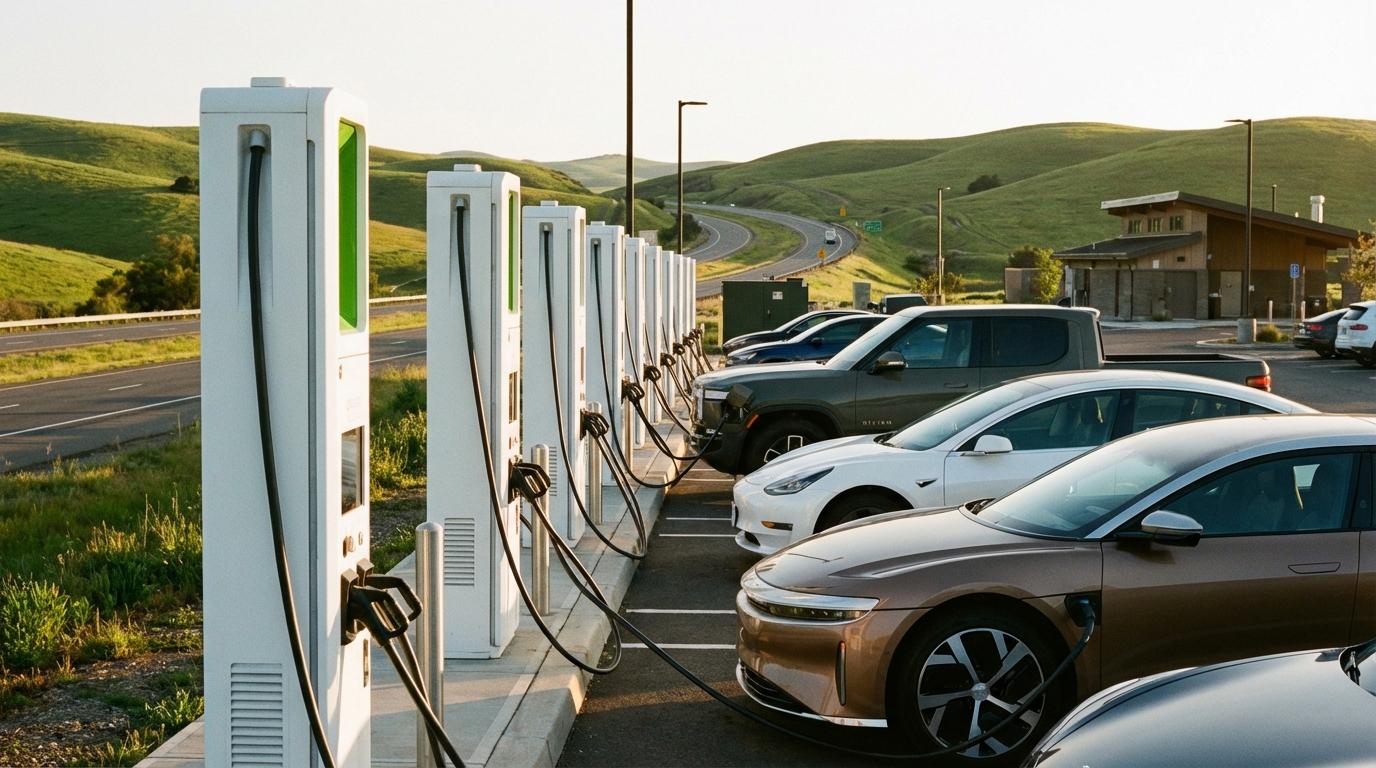
Treating an EV charging stop like a gas stop leads to the kind of afternoon I spent on a Tennessee interstate, watching a coworker’s range estimate shrink while the station we were aiming for turned out to have the wrong plug. Our company was sending four cars from Nashville to Atlanta for a conference, two of them electric, and I volunteered to plan the route because I’m the person at work with opinions about routing algorithms. My plan was the one I’d use for any drive, fastest path and as few stops as possible. I had looked at charger pins on a map and never checked which connector each one offered. It didn’t help that the map I was using drew every charger pin the same way, so a CHAdeMO-only station looked exactly like one that could charge either of our electric cars.
The station we were counting on only had CHAdeMO, and Dev’s car needed CCS. Our next compatible charger was farther than his battery wanted to go, so we crawled to a slow charger behind a car dealership and lost most of the day there. When we sat down afterward for a debrief on what went wrong with the trip, that stop came up before anyone had finished their coffee, and the conclusion was uncomfortable for me: the route was fine for the gas cars and wrong for the electric ones, and I had planned it as if they were the same thing.
The Gap Between the Map and the Charger
A charger map is a record of where hardware was installed, which is a different question from whether that hardware will charge your car today. PlugShare and the Department of Energy’s station locator both show dense coverage across the Southeast, and a pin on either can still be a station whose payment terminal died last week or where every stall is taken when you pull in. Of the two, PlugShare is more useful because drivers leave check-ins, so you can see that somebody charged successfully a few hours ago. That’s the closest thing to live status you’ll get without opening each network’s own app.
And you do end up opening each network’s app, because outside Tesla’s network most companies run their own app and their own payment setup. Tesla drivers I know complain about this far less than everyone else, though I haven’t seen reliability numbers I’d trust enough to repeat.
For every planned stop I now confirm the connector against the exact car that will use it, not against “EVs” in general. Then I pick a backup station that the car can reach from the primary on whatever charge it would realistically arrive with, which is usually less than the planner promised. It adds maybe an evening of work before a long drive.
The bigger change was the order. I build the EV stops first and fit the gas cars around them, since a gas car can refuel almost anywhere and an EV can’t.
Turning Charge Time Into Something Useful
Fast chargers are fastest when the battery is low, and the reason is battery chemistry. A lithium-ion cell accepts current easily when it’s mostly empty, but as it fills, pushing current in too hard risks plating metallic lithium onto the anode, which permanently eats capacity. So the car’s battery management system starts by asking for a constant current, then switches to holding a constant voltage while the current tapers off. On most cars that taper becomes obvious somewhere around 80%, and the stretch from there to full can take about as long as everything before it (which is why “how long does it take to charge” has no single answer, and why a charge that stops at 80% is the efficient one).
For a group, that means the useful fast-charge stop is about 30 minutes and ends well short of full. That happens to be the length of a meal.
On our later Nashville-to-Atlanta drives, the EV charging stops are the lunch stops. The gas cars stop there too even though they don’t need to, because splitting the group so the gas drivers can push ahead creates more coordination trouble than the pause costs. Level 2 chargers, the slow kind we got stuck at, belong to a different plan entirely: overnight at a hotel, or a long sit-down somewhere the cars would be parked anyway.
Where the charger sits matters more than I expected. A working fast charger in an empty lot next to an off-ramp is technically fine and miserable in practice, because there’s nothing to do but stand next to the car. Put the same charger at a shopping center with food and restrooms and the wait becomes an actual break for the drivers. I keep a running note of stations like that along the routes we use, and I’ll pass over a slightly closer charger to get to one of them. My coworkers still bring up the dealership whenever I offer to plan a drive.
Book the Hotel by Its Parking Lot
Hotels deserve more attention than they get in EV planning. More of them have Level 2 chargers now, and an overnight charge means the electric cars start the morning full without anyone standing at a station, so when I book for a multi-day trip I filter for on-site charging first and look at price second.
Mixed Groups Are the Hard Part
Most groups I plan for are a mix of electric and gas. Usually one person recently bought an EV and the rest drive gas, sometimes with a plug-in hybrid in there too, and you end up building one route around cars with very different needs.
The hybrid is the easy call. I treat it as a gas car, because when its battery runs down it just switches to the engine and keeps going.
For the full EVs I plan to arrive at every stop with at least 20% left. Part of that covers what the range estimate can’t see in advance, like a headwind or the long Monteagle climb between Nashville and Chattanooga, and part of it covers arriving at a broken charger with enough battery to reach the backup. Arriving low isn’t a disaster from a charging-speed point of view (if anything the car charges quickly there), but it leaves no room when the plan changes.
A Better Route Planner (ABRP) is what I use for the electric side. It factors in the specific car model and the weather along the route, and I run the EV route through it first, then lay the gas route on top to see where the two naturally meet.
The part no app does for you is the EV drivers saying, at each stop, how much charge they actually have, so the group can slow down or reroute while there are still options. Seeing everyone on one live map helps too, since nobody has to call around to find out who fell behind on the last climb.
On the next Atlanta trip, Dev posted his battery percentage in the group chat at every stop without being asked, and at Chattanooga he had enough left that we skipped the backup charger and kept driving.