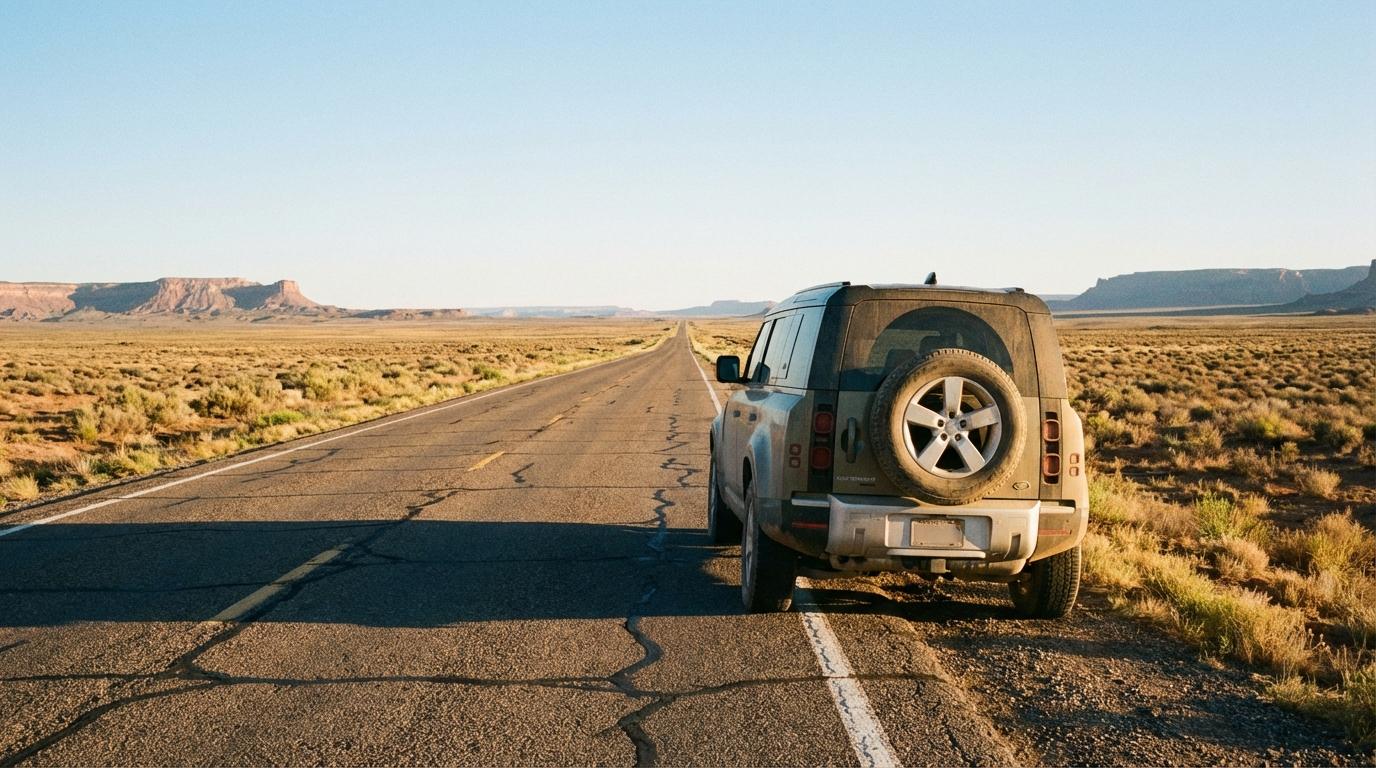
I once drove US-93 from Kingman down to Wickenburg in July with one liter of water for my brother, a friend and me, and I really thought we were fine. The road was paved. We had a full tank in a rented Chevy Malibu, I had looked at the map and seen a couple of hours of driving, and I packed the way you pack for a trip to the mall.
Every desert drive I plan now starts in my driveway with the trunk open, going through the worst version of the day before the car has moved at all (my brother calls this my funeral planning, and he has a point). I do these drives with friends a few times a year, and the ones who come along regularly have learned to bring a coffee and wait out this part. Most of what follows came out of that one afternoon in Arizona, and the rest came from smaller mistakes since.
How Much Water We Carry
I know two gallons per person per day sounds like a lot when you’re carrying it out to the car. That’s still my baseline, and it assumes the AC works and nothing breaks. When I started doing these drives I figured a gallon each was generous, and the first summer I paid attention to what we actually drank, we were through it by mid-afternoon.
Packing guides tend to forget the car needs water too.
If a coolant hose splits out there, you either have spare water to nurse the engine to the next town or you sit on hot asphalt waiting for whoever comes along. So every car in my group carries a separate jug marked “vehicle only” (masking tape and a Sharpie, nothing fancy), and nobody drinks from it unless we’re well past caring about the engine. It has gone into a radiator more than once. For drinking water I use Scepter military-style cans because they stack flat in a trunk and don’t leak when they tip over, which they will on a rough shoulder. My friends make fun of the cans right up until somebody’s cooler lid pops open and soaks the snacks.
Spread the water across every car in the group, even if one trunk is obviously bigger. If the car with all the water is also the car that breaks down a long way back, everyone ahead of it is carrying an empty cooler.
And if you do get stuck, drink it. Your body can only use water that’s inside you, and dehydration starts to cloud your judgment early, right when you need it to decide what to do next. If someone in the car gets a headache or turns quiet and irritable, hand them a bottle before you do anything else.
The Gas Station You Were Counting On
Some paved highways in the Southwest go a very long way between gas stations. These are proper roads with speed limits and the odd sign about rock formations. They just don’t have services, and the few that exist sometimes close at dusk.
Work out your car’s real range with the AC running flat out and the trunk full of water. It will be lower than the estimate on the dashboard and a lot lower than whatever the rental counter told you, so take a bit more off for comfort.
I top off at every gas station we pass, even if we filled up an hour ago.
In a group, the car with the smallest tank sets the range for everyone. If that’s the little rental hatchback, the truck with the long-range tank doesn’t get a vote on where we stop. A spare fuel can helps (strapped down, and outside the cabin if the car allows it), but I plan every leg as if we didn’t bring it.
What Heat Does to Your Car
Tires worry me more than anything else on the car. Desert pavement gets much hotter than the air, and an underinflated tire flexes more, builds heat and eventually lets go. Check pressures in the morning while the tires are cold. If they read high later in the day, leave them alone (that’s normal expansion), because letting air out means they’ll be underinflated once everything cools down.
I learned that on the interstate south of Las Vegas, with a rear tire that blew in the middle of the afternoon. The pavement was hot enough that I could feel it through my boots, and kneeling on it to put the spare on went straight through my jeans. That tire had been at the low end of acceptable when I left that morning. I had looked at the gauge and decided it was fine. Now if anything reads even slightly under spec, I deal with it before the car moves, and I carry a Viair portable compressor that plugs into the power socket. Out of all my gear, that’s what I’d buy first.
When the temperature gauge starts climbing, turn the AC off and the heater on full with the fan on high. It’s miserable, and it pulls heat away from the engine. If the gauge keeps climbing anyway, pull over somewhere safe, switch the engine off and wait. Don’t touch the radiator cap until the engine has cooled down completely, because a hot system can spray scalding coolant at you. Batteries are the quieter problem. Heat wears them out faster than cold does, so if yours is old or you can’t remember when it was replaced, get it tested before a summer trip (most auto parts stores will do it while you wait).
If the Car Won’t Move
Stay with the car.
A car is much easier to spot from the road or the air than a person walking, and it gives you shade even with the engine off. Walking in that heat burns through water far faster than sitting does. Search and rescue teams in the Southwest give the same advice, and I make sure everyone in my group has heard it before we leave town.
With signal, call for help and stay put. Without signal, make yourself easy to find. Put the hood up and tie something bright to a mirror where passing drivers will see it. In a group, the people with a working car go for help while somebody stays with the broken one, with water. On your own, you stay in the car’s shade through the worst of the heat and wait for traffic.
Before You Leave the Driveway
A printed checklist lives taped inside my glove box, because nobody thinks clearly before dawn. The item I forget most is the paper map, the folded kind from a gas station rack. I once stood on a desert shoulder with a dead phone and no idea which way the last town was, and I have bought a paper map for every region I’ve driven through since. A tow strap goes in as well, after a friend’s car slid into soft sand at a pullout and we would have been there all afternoon without one. If the route has long stretches with no coverage, I also borrow a Garmin inReach Mini from a friend, since it can send a message by satellite when the phones have nothing.
Tell someone at home your actual route, with highway numbers and the times you’ll check in. If we’re well past a check-in and they haven’t heard from us, they call the authorities, and we agree on that before we go.
Groups Are Safer, If They Stay Together
A group is safer in the desert as long as it behaves like a group. Once the cars are far enough apart that nobody can see anybody on a road with no coverage, you’ve lost most of the reason you came together.
I’ve been the driver who pulled too far ahead. On a drive through southern Utah I got impatient behind a slower car in our group and pushed on, figuring they’d catch up at the next gas station. They didn’t show up for most of an hour. It turned out they had pulled over to look at a tire that was making a noise, and with no signal they had no way to tell me. I sat in that parking lot watching an empty highway and thinking through everything that could have gone wrong (and I’m the one with the checklist taped in the glove box).
Now we agree on spacing before we leave. On long straight roads the car behind should stay in view, and if it drops out of sight in a canyon, the front car waits at the next pullout.
We also share live location during the drive, using the kind of real-time location sharing app that saves you calling each other to ask where everyone is. It needs signal too, which matters out here. When a car loses coverage in Konvoyage, its dot fades and shows “no signal” with how long ago it was last heard from, and the phone keeps saving its positions and sends them once it has signal again. You won’t see someone pull over in a dead zone while it’s happening, but you will know where they were last seen, which beats guessing along a long stretch of empty highway.
With a bar of signal, the app also tells everyone in the trip when a car has been stopped for a while, which is one of the few notifications worth having while you drive. My passenger reads those out, so the driver never has to look at the phone.
Back on US-93
By mid-afternoon on that Arizona drive, the thermometer on the dash read 112 and the Malibu’s AC was losing. My brother had a headache he blamed on my music. It was an early sign of dehydration, which I know now and didn’t know then, and there was almost nothing along that road where we could have bought water. We reached Wickenburg and drank bottle after bottle at the first gas station we found, standing in the shade next to the ice machine while my friend refilled our one liter bottle at the drinking fountain.
My brother still asks if we’re done yet while I count jugs in the driveway. We’re done when there are two gallons each in the trunk and the vehicle-only jug is full.