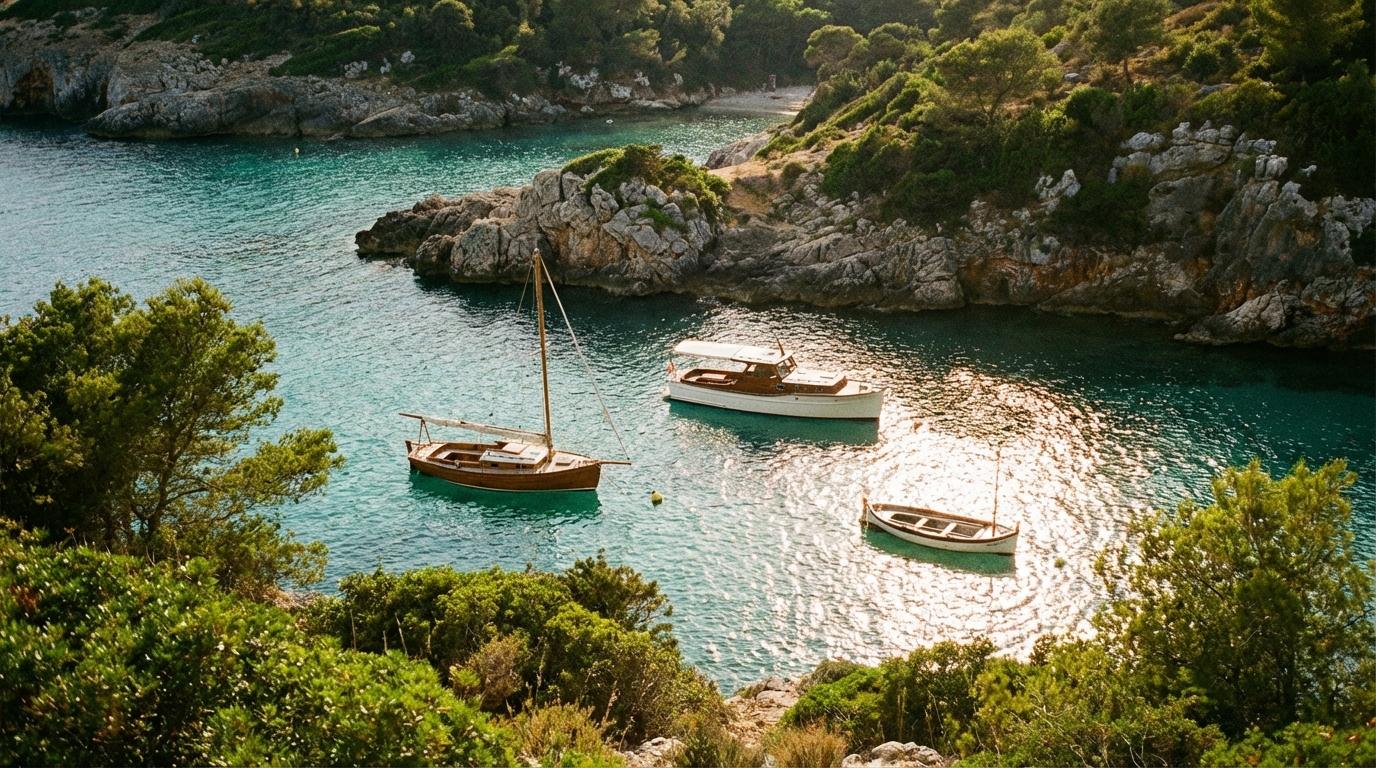
Sounds carry differently across water, and you notice it most when you’re idling three boats outside a channel marker, engines burbling at different pitches, the VHF crackling with half-conversations from other skippers somewhere beyond the point. You can hear the water slapping fiberglass and the gulls working a bait ball near the rocks, and under all of it there’s the low hum of Tess’s outboard, because she keeps forgetting to drop her revs when you’re all just sitting there waiting to move. Then somebody points at the gap in the mangroves where the cove is supposed to be. Nobody has been through it before, and you realize the other boats are watching to see what you do first.
I’ve been that front boat more times than I’d like, and for years I did it badly.
Everyone Needs Their Own Chart
My old method was to pick a line from the lead boat and have everyone else follow single file like ducklings, and it felt efficient enough that I never questioned it. Then I watched an episode of Sailing Uma on YouTube where they talked about getting through unfamiliar passages alongside other cruisers, and the part that stuck with me was how much they cared about each boat knowing its own draft and how it sat over the bottom it was crossing. Following the lead boat assumes every hull draws the same water. I learned otherwise on a shallow shelf near Islamorada, where my center console cleared with room to spare and Tess’s heavier walkaround, running a few boat lengths behind me, did not. She was going slow, thankfully, so it was a scrape on the lower unit and a lot of swearing rather than anything worse. I still remember how loud that scrape was across the flat water, and how long it took her to look over at me.
Follow-the-leader stopped being my plan after that, though I still catch myself drifting into it on calm days when the water looks deep everywhere.
A dedicated marine chartplotter does a better job here than most people expect, because it shows depth contours and your own track on the chart, and it sits in a mount where you can glance at it without picking anything up. Phone apps like Navionics and iNavX have gotten good, and for fair-weather coastal runs they can be enough. They also eat batteries, and a phone in a waterproof pouch fogs up by midafternoon until you’re wiping it on your shirt and squinting at a blur of blue. When three boats are lining up for a narrow entrance, I want every skipper looking at the depth under their own keel, on a screen they can actually read in the glare.
A harbor master in Beaufort, South Carolina, a man named Dale who has spent most of his working life pulling boats out of trouble along the Intracoastal, put it more bluntly than I could. “When I see a group of recreational boats coming through a narrow cut, the ones that get into trouble are always the ones where only the first boat has a plan,” he said. “Every captain needs to know what’s under their own boat.” He’s pulled boats off sandbars where the skipper’s entire strategy was keeping the lead boat’s stern in sight, and he figures he’ll be doing it again before the summer is out.
Friends driving to the same campsite deal with a milder version of this, which is why real-time group navigation on roads gives every car its own directions instead of asking everyone to tail the leader. On water that job falls to each skipper and their own chart. You can see your friend’s boat a little way ahead and still have no idea why she just swung hard to starboard, unless you’re looking at the same chart she is.
The No-Wake Sign That Bunches Everyone Up
No-wake zones exist for good reasons, and they also cause one of the trickiest coordination problems in group boating. You’re running at cruise speed with the boats spaced about a hundred yards apart, and then the lead boat passes a no-wake marker and drops to idle. The middle boat reacts to that, the last boat reacts to the middle one, and your neat line squeezes into a floating traffic jam of transoms and confused throttles. If you’ve ever been the trailing boat, you know the sinking feeling of watching the sterns ahead get closer while your own hull keeps sliding forward, because a loaded boat doesn’t stop just because you’d like it to.
What helps is agreeing on wider gaps before you get anywhere near a stretch with known no-wake zones, wider than feels right. Staying close feels like staying together, but on water it mostly means bouncing in each other’s wakes and having nowhere to go if the lead boat stops hard for a kayaker you couldn’t see from behind.
When the Chop Picks the Pace
When the weather builds, boats handle it differently depending on their hull and whoever’s at the helm. A chop that’s a mild annoyance on a heavy walkaround turns into tooth-rattling punishment on a light flats boat, with spray coming over the bow and the cooler sliding into your shins every time you come off a wave. Keeping the group together in that means accepting that you won’t all run the same speed, and that the most uncomfortable boat sets the pace even if yours could happily go faster. Check on each other by radio as well as by sight, since the skipper taking the worst beating is often the one too stubborn to ask for a course change.
I’ve spent a whole gray afternoon watching a friend’s bow lift and slam off my beam, unable to do anything except keep the radio on and point out the nearest bit of protected water. It’s the least fun kind of boating, and the groups that get through it with the fewest arguments are the ones that talked about bail-out spots at the dock that morning, back when the sky was still blue and everyone was in a good mood.
“What If We Lose Each Other?”
Somebody asks this on every trip, usually while untying lines. On roads, finding a lake house with no street address is tricky enough, and water takes away even the street signs and mile markers. If a boat falls behind or takes the wrong channel, the ways to reconnect narrow fast. Dropped pins and live location sharing on a phone help, but only while the phone has signal, and plenty of the best coves sit where coverage is thin or gone. VHF covers the talking, though telling someone to “head north toward the big rock” is about as useful as it sounds when there are several big rocks and north is a wide direction.
What actually works is loading the cove’s coordinates into every boat’s chartplotter or nav app before anyone leaves the dock, with the real entrance and the spot where you plan to raft up marked rather than a rough idea of the area. Then if a boat peels off for fuel, or because somebody’s kid is turning green, that skipper can make their own way in without following anyone or calling for directions.
Dale’s line about every captain needing their own plan is what I repeat at the dock now, usually to people who are only half listening. Some days the right move is to spread out and let each boat pick its own line through the chop, then meet in the lee where the wind drops and the anchor finally holds. Somebody opens a cooler while Tess’s outboard keeps humming, because of course she forgot her revs again. One at a time the engines go quiet, and after that there’s only water lapping against three hulls in the same hidden cove.