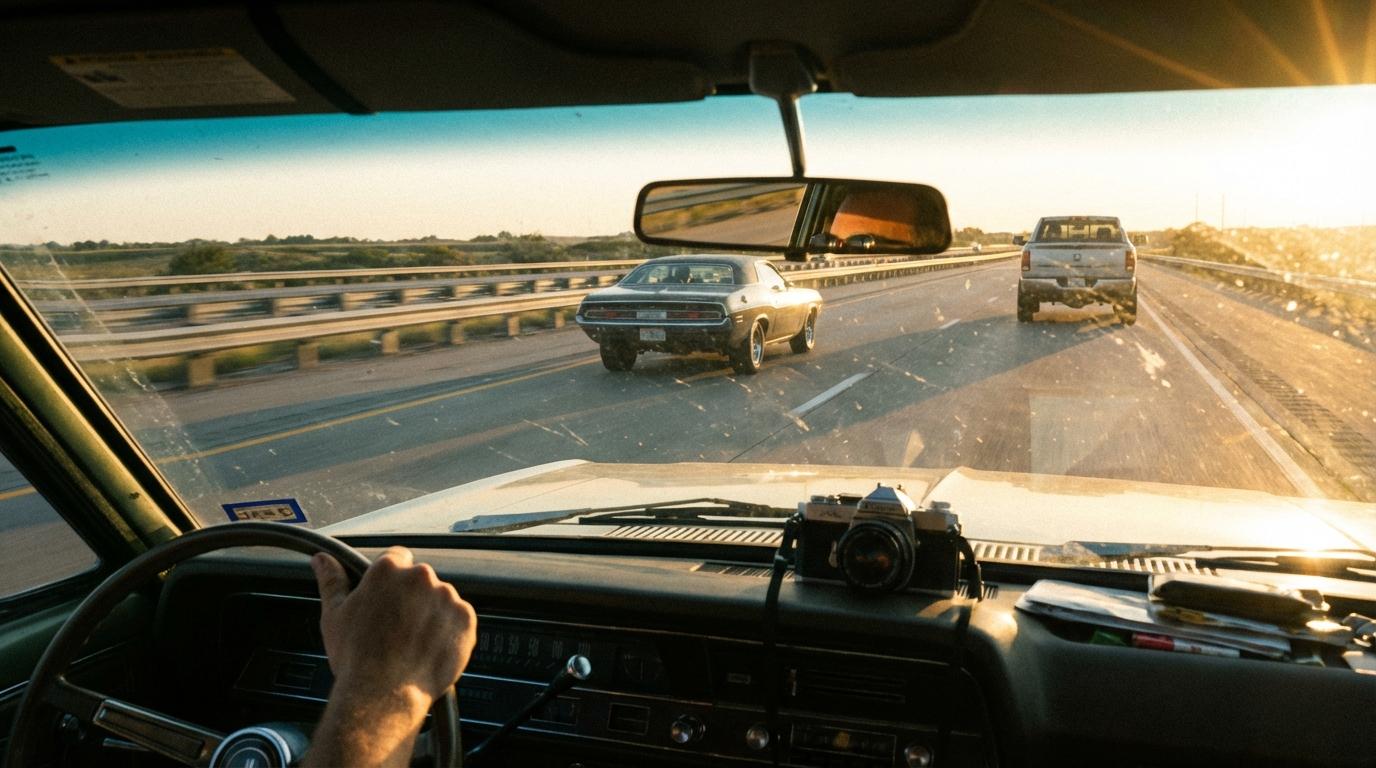
Every summer my family drives from Charlotte to Myrtle Beach in my dad’s Camry and my brother’s Civic Si, and every summer the cars drift apart before we’ve cleared the last Charlotte suburbs. Dad gets in the right lane, sets cruise control to exactly 7 under the limit, and stays behind whatever semi he finds first. My brother treats the on-ramp like a qualifying lap. I ride with Dad (I always pack the cooler, so I go where the cooler goes), which means I spend most of the drive watching my phone for a text from my brother that says he’s already at the house. By the time we pull into the driveway, nobody wants to bring up the drive, because the last time somebody did, it turned into a real argument next to a gas pump.
For years I blamed my brother, and for a while after that I blamed Dad. Somewhere around my mid-twenties I noticed we’d spent every one of those drives trying to make them drive the same way, which was never going to happen.
Groups argue about routes and snacks too, but those arguments are usually over by the first gas station.
Dad will never pass a semi
You are not going to talk someone out of their driving style at a rest stop (I’ve tried, with charts, and I’m not proud of it). The way a person drives comes out of a lot of years, mostly the close calls they’ve had and how much control they need before they can relax. Dad hydroplaned on a wet stretch of highway when he was younger than I am now, and he has driven like a man carrying a wedding cake ever since. My brother has never had anything worse happen than a curb rash on a wheel. Neither of them is driving that way to make a point.
If you’ve been in the parking-lot version of this talk, you know the script. Somebody says to just do the speed limit, somebody else says the flow of traffic is faster than the sign, and both people walk back to their cars sure they were the reasonable one.
I’ve had that exact conversation with my brother more times than I can count, and I’ve lost all of them.
For years my plan was the pre-trip talk. We’d agree on a speed and a following distance, and whoever was in front promised to check the mirror. It never held up past the first merge. Once a truck is throwing grit at your windshield and someone is riding your bumper, the agreement from the driveway is gone, and you drive the way your body wants to drive. My brother wasn’t breaking a promise when he disappeared up the interstate. He just forgot he’d made one, which, honestly, is worse to argue with.
So I stopped trying to fix the drivers and started planning around them.
Who should be in front
Most groups put whoever “knows the way” in front, or whoever owns the biggest car. That’s backwards. If your group has a mix of drivers, the lead car should be whoever drives most like the middle of the group. Put the most cautious driver up front and everyone behind crawls, and the person directly behind them starts making small, impatient passes that are more dangerous than just going faster would have been. If the fastest driver leads, the rest of the cars spend the morning trying to hang on, and somebody loses sight of the lead car before the first exit you actually needed. After that it’s a guessing game about which way he went.
With only two cars, we never had a middle driver, so Dad led on paper (he knows the back roads) and my brother led in practice. A split at a single red light can do the same thing to a group, and it’s worth reading about if your route goes through towns instead of staying on the interstate.
The careful car and the fast car need different things
Tailgating a cautious driver doesn’t speed them up (neither does sighing in the passenger seat, which I know from experience). Dad leaves a huge cushion in front of him and brakes for curves that don’t need it, and the thing that actually helps him is knowing what’s coming. If he has the route and the stops the night before, he relaxes a little, and if he can also see where the rest of us are on a map without calling anyone, he stops worrying that he’s been left behind and drives better for it. The rural stretches past Florence used to be the hard part, because that’s where calls drop. Now, when a phone loses signal, its dot on the map fades and says “no signal,” and the phone keeps recording where it went and sends those positions once it reconnects. That’s a big part of what convoy intelligence actually means on a road like that one.
He also likes being the one who knows where the next bathroom is.
The fast driver needs something else entirely. My brother isn’t trying to scare anyone. Slow traffic bothers him the way a tag in a shirt collar bothers some people, and he isn’t really aware of his speed until someone points it out, at which point he’s annoyed instead of slower. What works with him is permission. He goes ahead, he waits at the next stop, and nobody pretends he’s going to stay in Dad’s mirror.
That permission only works if everyone can still see everyone. We started using Konvoyage for the beach drive, which puts all of us on one live map, each with turn-by-turn navigation. Once the gap between the front car and the back car passes 10 km straight-line, the whole trip gets a “falling behind” alert about the back car, so nobody has to be the person who notices and calls. When that alert shows up and Dad wants a break anyway, I tap “Wait for me” on his phone and my brother pulls off at the next exit. Most days Dad is fine and just slower, so he has me send “Go ahead without me” (he won’t touch a phone while driving) and nobody needs to discuss it on speakerphone while merging.
Stop every 90 minutes, even if nobody asks
Plan more stops than feels necessary. When the group regroups every 90 minutes or so, the gap between the fastest and slowest car never gets big enough to turn into a grudge. The fast car gets there first and buys coffee, and the slow car rolls in a few minutes later. Over a long leg with no break, the gap keeps growing, and so does whatever the slower car is muttering about it.
On our last beach trip the planned stop was the Buc-ee’s in Florence. My brother got there well ahead of us and had already bought a beaver-shaped air freshener and hung it from Dad’s mirror before Dad had the engine off. Dad left it there the rest of the summer.
Say it before you leave the driveway
The pre-trip talk I recommend now is shorter than the old one. Everyone admits out loud that the cars will spread out, and you settle how you’ll find each other when they do. I know that sounds too simple. The reason it’s hard is that nobody wants the label: the cautious driver doesn’t want to be the slow one, and the fast driver doesn’t want to be the reckless one, so everyone says they’ll “just drive normal.” Normal then means something different in each car, and you find that out somewhere on the interstate instead of in the driveway, where everyone was still in a good mood.
This July was the first beach drive where nobody called anybody. Dad was in the right lane before we’d finished merging, cruise control on, the same podcast he always plays. My brother was out of sight not long after that. Around the halfway point the gap was about 15 minutes, which is what it always is, and I checked the map, saw both of their dots moving, and went back to reading. Nobody used the voice that sounds like “where are you” but means “why aren’t you driving like me.” We all ended up in the driveway, and the first thing anyone said was who was going down to the water first.
I still pack the cooler in Dad’s car, and I still sit with him, partly because I like his podcast more than I admit and partly because he lets me pick the stops.
Which one are you in your group, the one in the right lane or the one who’s already at the house?