Last spring my friend Devon spent weeks putting together a surprise birthday trip for her girlfriend Tess, and it fell apart in their own driveway before the engine had even warmed up. Tess popped the glove box looking for sunglasses, and folded on top of the registration was a printed confirmation for a cabin outside Gatlinburg, with “birthday weekend!!” typed into the notes field by some cheerful booking clerk. According to Devon, Tess just held it up without a word while the air conditioning blew lukewarm air at both of them. They went anyway. Devon tells the story at every dinner where somebody mentions a birthday, and she still hasn’t decided whether it’s funny yet.
The booking clerk gets most of the blame in her version, though I think a printed confirmation in a glove box was always going to turn up on the wrong day.
I learned that from the other side when a group of us planned Priya’s thirtieth last October. A week before the trip, at brunch, she leaned over my shoulder just as the planning chat lit up my lock screen with a message about the cake, and I flipped the phone over so fast it skidded across the table into a little dish of jam. I told her my landlord was texting about a leak, which made no sense at all, and she let it go, though I could tell she was filing it away somewhere.
Where the planning actually happens
Before anyone books anything, move the planning somewhere the birthday person never goes. If your group lives in iMessage, set up shop in Signal, or make a Discord server with a name so dull nobody would ever tap on it, something like “Apartment Utilities.” Then every person in that chat turns off message previews on their lock screen for it. My jam incident happened because I’d skipped that step, and the preview said “cake” in plain view of the person the cake was for.
Give the birthday person a codename in the chat as well. It feels silly, but when somebody pastes a message into the wrong thread, a line asking what time the Walrus gets in can be laughed off, and a line asking what time Priya gets to the cabin can’t.
Searches can give you away if you share a laptop or a Google account with the birthday person, because a week of looking at mountain cabins can follow you both around in the ads, so do that research in a private window and close it when you’re done.
The friend behind the wheel
Every surprise trip needs a Handler, the friend who spends the day of departure with the birthday person and gets them into the car without a fuss. For Priya that was Marisol, her roommate from college, who is a terrible liar about most things but somehow steady when it counts. A good cover story has to explain the packed bag and why the whole weekend is taken, and “my aunt’s place in the mountains is empty, come with me” managed both. Marisol even complained ahead of time about the aunt’s bad wifi, which I thought was overdoing it until Priya asked whether she should bring a book. By the morning they left, Priya had packed hiking boots and a sweater for a trip she thought she understood completely.
Keep the final destination off any navigation screen in the birthday car. Marisol had camped around Idyllwild for years and drove it from memory, and when Priya asked where exactly this aunt lived, she said “past the town, I’ll know the road when I see it,” which was vague enough that Priya stopped asking.
The rest of the group
Nobody else should drive up the highway close behind the birthday car, where Priya might spot a car she knows in the side mirror. We left from Long Beach and Pasadena at different times and didn’t lay eyes on each other until the cabin. Jordan and I took the road through Hemet and ate lunch from a taco stand there with the windows down, salsa dripping onto the map Jordan had printed for no reason anyone could explain.
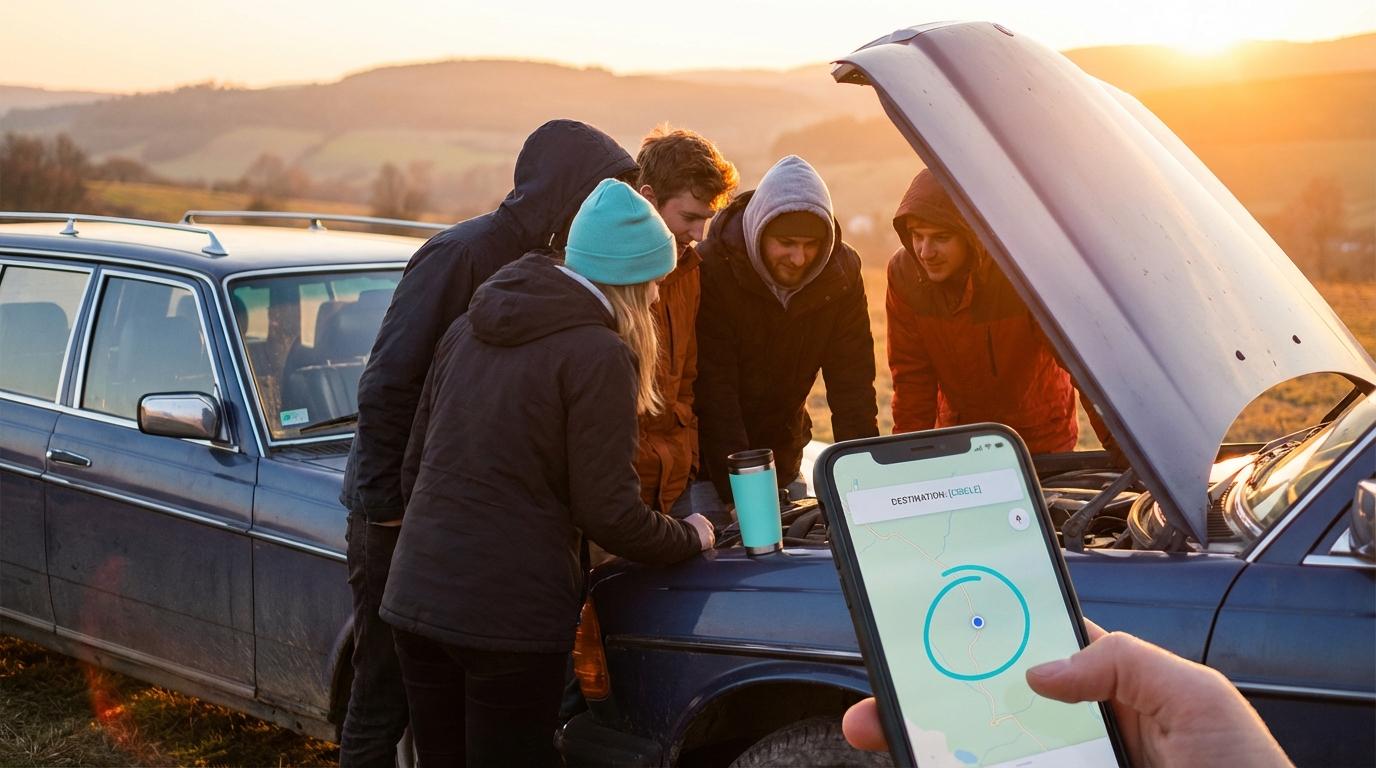
Tools like Konvoyage work across iPhone and Android, so whoever is coordinating can see where every car is in real time without the birthday person’s car needing to be part of the group. Our cars were in a trip together and Marisol’s wasn’t, which meant there was no map on any screen Priya might glance at, and nothing to explain.
The part I didn’t expect to love involved Priya’s mom. She had driven up the day before with the cake in a cooler and spent the afternoon hanging paper lanterns from the porch rail, and she didn’t have the app and had no plans to install it. Jordan, riding in our car, opened the trip pill at the top of the map and sent her a “Share live view” link by text. She opened it in the browser on her laptop and watched our dots crawl up the mountain road, each with a first name and an “arrives” time next to it, without making an account or downloading anything. Later she admitted she kept reaching for the refresh button out of habit and then remembering the map moved on its own. Once the trip ended on her screen, meaning every one of us had pulled in, she texted Marisol a thumbs up.
When they start to suspect
Priya worked out a few days before that something was going on, and we let her, as long as she had the wrong idea about what. Marisol let it slip, on purpose, that “we might be doing a little dinner thing for you,” and Priya relaxed the way people do once they believe they’ve worked you out, spending the drive guessing restaurants and never once guessing a cabin full of people who had driven out from LA.
If the birthday person gets invited somewhere else that weekend, don’t forbid it. A light “oh, I thought we had plans?” lets them back out on their own without wondering why you care so much about their Saturday.
Buying time on the last stretch
When the destination is the surprise, everyone else has to get there first, which means the Handler needs to run late without it looking deliberate. Marisol stopped for gas in Banning when the tank didn’t need it, then pulled over at a fruit stand on the way up and took forever choosing apples, the stand smelling of cider and dust, the guy behind the counter happy to talk about every variety he had. Priya thought it was sweet and had no idea Marisol was waiting on a text.
Pick a single person to film the reaction, with the camera already running before the door opens, because when everyone holds up a phone you get a wall of screens instead of faces.
Collect short video messages from the friends who couldn’t come and play them after dinner, when everyone is full and sleepy and less embarrassed to cry. Priya’s grandmother recorded hers at her kitchen table in Fresno, squinting at the camera and mostly asking whether Priya was eating enough. Her cousin’s video came in sideways and nobody could work out how to rotate it on the cabin’s TV, so the whole room watched it with our heads tilted.
After that, leave the weekend mostly empty and see what people feel like doing. We had a hike planned for Saturday morning and nobody went, because everyone was still out on the porch wrapped in blankets well past breakfast, drinking bad coffee and arguing about whether the lights crossing the sky the night before had been satellites or planes.
When Marisol’s car finally crunched up the gravel, the cabin was dark and all of us were packed behind the kitchen island, trying not to breathe too loudly. Priya walked in holding the bag of apples just as somebody hit the lights, and she screamed and dropped the whole bag, and the apples rolled under the couch, where we kept finding them for the rest of the weekend. Her mom’s laptop was still open on the counter, the live view page now saying our trip had ended and offering to show a replay. Priya, once she could talk again, pointed at it and asked what that was. Her mom said it was nothing and shut the lid.
Over pancakes the next morning we did a sort of group trip debrief about who had nearly blown it, and the jam came up before anyone had finished their first cup of coffee.