Most people picture a digital map as finished work, as if someone drove every road once and the job ever since has been touch-ups, a pothole here and a new coffee shop there. I believed that too, until a late-night research rabbit hole took the idea apart in about fifteen minutes.
What rearranged my thinking was where a lot of the freshest road data comes from: phones, ordinary ones in ordinary pockets, sending location readings back to map companies while their owners drive to work or to the grocery store. Your phone has probably done some survey work this week, and the permission for it sits somewhere in a settings screen you tapped through years ago.
Camera cars get the attention
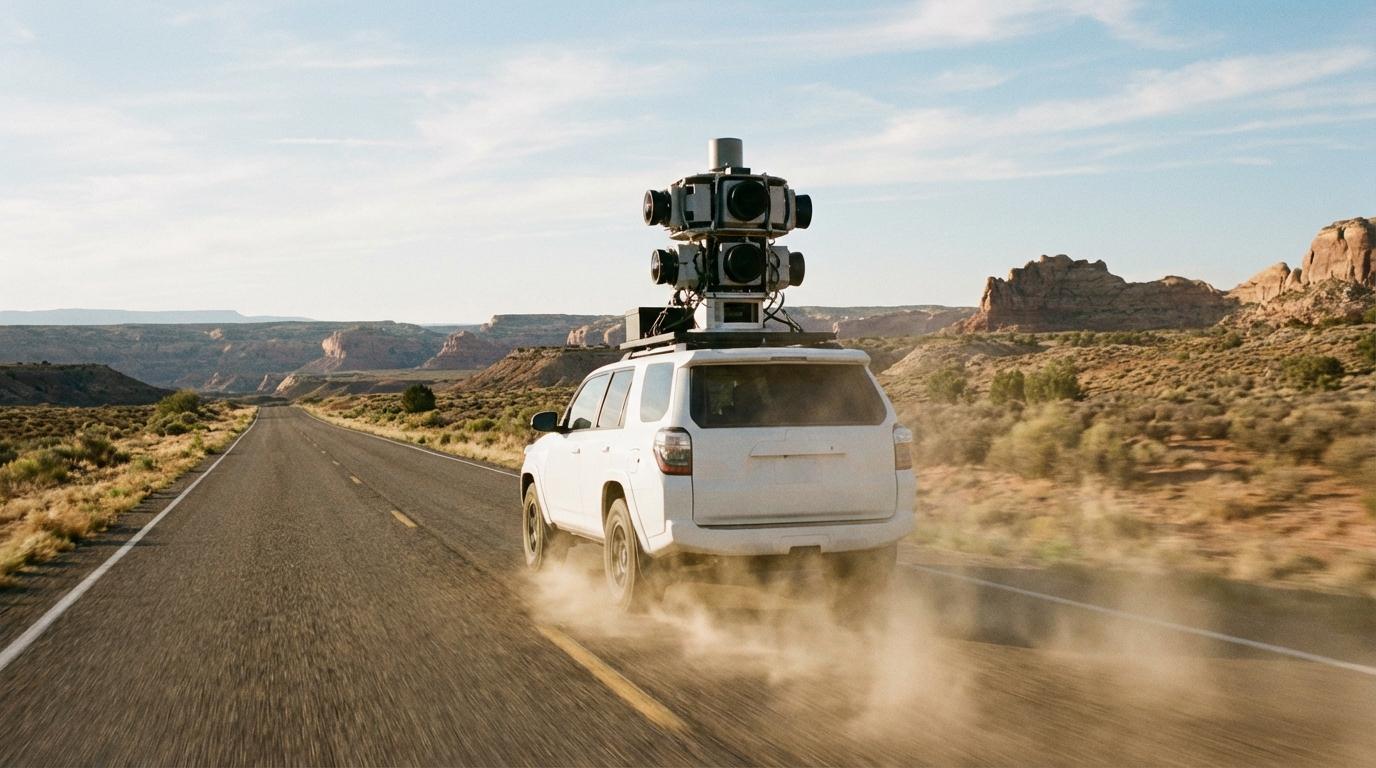
Google, Apple, HERE and TomTom all run survey vehicles fitted with roof-mounted camera rigs and LiDAR. You’ve probably passed one, the car with the odd mast on top that makes people point. They capture road geometry in a lot of detail, down to where each sign stands and how wide each lane is.
What surprised me was how little of the road network they cover on any regular schedule.
Survey fleets return to busy city streets far more often than anywhere else, while some rural roads and new subdivisions have been driven once, and some never. A car can only be on one road at a time, and the US alone has more than 4 million miles of public road. Even a fleet of hundreds can’t keep that whole network fresh, so the companies prioritize. Roads that lots of people use get driven again, and the rest are left to age until something else flags a change.
That’s why the last half mile to a cabin or a lake house is so often wrong or missing. The road is there, but nobody with a LiDAR rig has been down it since it was paved, so the routing engine is working from older data or making a guess. (If your destination doesn’t have a proper street address at all, there are ways around that, but they take some planning before you leave.)
The phone in your pocket is doing survey work
When you drive with a navigation app open, and on many phones whenever location settings allow it, the phone sends position readings back to the provider. In the industry this is usually called probe data, and Google, Apple, HERE and TomTom all use some form of it. The readings are supposed to be stripped of anything that identifies you before they get pooled with everyone else’s. (“Anonymized” describes what the company does to the data afterward; researchers have shown more than once that raw location traces can sometimes be tied back to a specific person.)
Probe data earns its keep through the sheer number of readings. A single phone wandering off a known road means nothing, since people stop for gas and cut through parking lots, but hundreds of phones taking the same new path week after week mean the road has probably changed. Because the readings keep arriving, the map of a busy road can update in days instead of waiting for the next survey drive.
The detection side is the part I find most interesting. Picture a stretch of highway where traces have followed the same curve for years, and then over a couple of weeks a cluster of them starts bending a little south of the mapped line. The system has no idea why this is happening, only that the traces and the map disagree, so it flags the spot. From there the provider can pull fresh satellite or aerial imagery, see whether a new interchange went in or a lane was shifted for construction, and redraw the road. Some of that is automated and some still goes to human editors, and the providers don’t publish exactly where that line sits. Speed works the same way: when traces on a road mapped at highway speed start crawling every afternoon, the routing engine learns something from that too, which is a big part of how live traffic works.
The weak spot is that probe data only exists where people drive, so a quiet road to a trailhead might go months without enough traces to show that anything changed.
It’s a strange thing to rely on every day, a map built largely out of strangers’ commutes.
Satellites see the road but not the rules
Satellite and aerial imagery fills in a lot of what the cars and phones miss. Imaging companies such as Maxar and Planet photograph huge areas on a regular basis, and machine learning models scan those images for new pavement and widened junctions.
The limit is what a picture from above can tell you. A satellite can show that a road exists, but it can’t show that the road is one-way or what its speed limit is, and those details still come from survey cars reading the signs or from enough phone traces to show which way traffic actually flows.
OpenStreetMap, and the people who fix things for free
OpenStreetMap, the open world map built by volunteers, has contributors ranging from people who correct one misplaced restaurant pin to people who spend whole weekends tracing roads from aerial imagery and checking them against GPS tracks from their own drives.
I once read a post from one of the second kind about a weekend spent mapping a brand-new subdivision. The developer hadn’t sent updated road records to the county yet, delivery drivers kept getting lost, and the editor got annoyed enough to fix it. Nobody paid for any of it, and work like that still ends up in commercial maps.
OpenStreetMap data sits underneath apps built on Mapbox and under Apple Maps in some regions, and TomTom’s newer map is built partly on open data through the Overture Maps Foundation, a group it co-founded with several big tech companies.
Under all of it, the county records
In the US, the Census Bureau publishes TIGER/Line files with baseline geometry for roads across the country, and state transportation departments keep their own data on highways and bridges. Map companies use this public data as a starting layer. It’s free to use but often lags behind reality, because a road can be open and carrying traffic well before the county’s GIS records catch up.
Everything else gets layered on top of that base to catch what the records miss, and the result is more current than any single source. When your signal drops in the hills, you’re driving on whatever version of that layered map your phone cached before it lost connection. On a group drive that’s often the moment cars lose track of each other, and having everyone’s ETA in one shared view is what cuts down on the “where are you?” calls once signal comes back.
What I think about now when the route looks wrong
I used to get annoyed when navigation sent me toward a road that had been closed for months, or didn’t know about one that had just opened. Now I think about where I am before I blame anyone. On a busy road near a city, the map is probably current to within days, because thousands of phones go over it. A gravel road to a lake is another matter, where the map may be working from a survey drive and a satellite image that are both years old, with too little traffic to correct either one. Out there I give the signs in front of me more weight than the line on the screen, and I’d tell anyone leading a group to do the same.
What I still can’t pin down is how long the quiet roads take. If you’ve watched a new road near home take ages to show up, how long was it before your navigation started sending you down it?