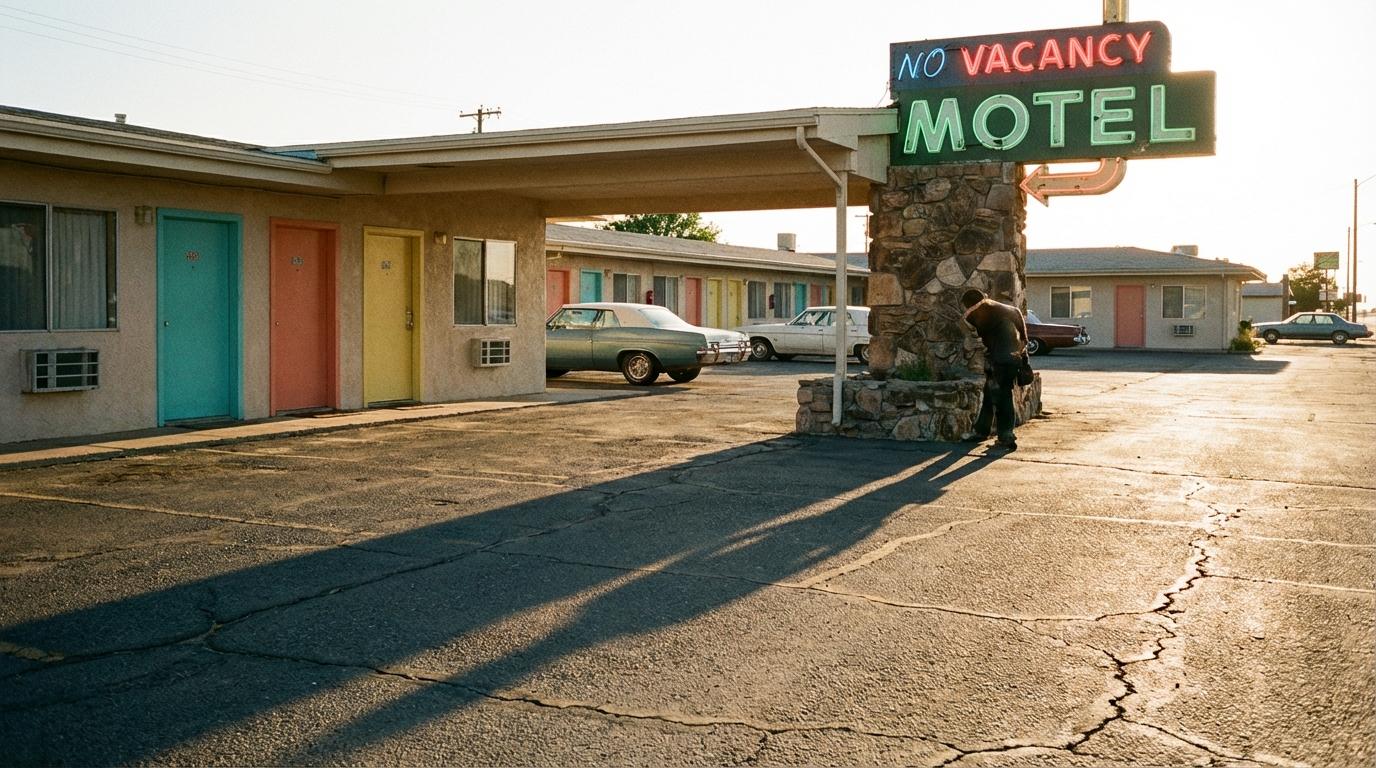
Last October my family drove the whole of Route 66, Chicago to Santa Monica, in my dad’s plug-in hybrid and my grandmother’s old Buick, with my parents in the hybrid and me riding in the Buick with my grandmother and my nephew. She was 82 and walked with a walker, and he was 9 and couldn’t sit still past Joliet. We stayed on the old road the entire way, past motels with neon signs older than my mom, and the problems I hadn’t seen coming mostly waited for us in New Mexico.
Before we left I had done all the homework I thought mattered. My spreadsheet knew which gas stations had clean restrooms and which diners had food my grandmother could eat. Whether she could actually get through the door of the rooms I’d booked never made it onto the spreadsheet.
Keeping both cars on the same plan took more care than I expected. We ended up playing the same audiobook in both cars and arguing about it over lunch, which is pretty much the case I made for audiobooks over music on long convoy drives.
Grandma Didn’t Set the Pace, the Kid Did
My dad wanted long days with the cruise control set, but Grandma needed to stand up and stretch her hips far more often than that, and my nephew needed it more often still, usually just past the last gas station for miles. Whoever needs the most stops runs the schedule, and on our trip that was the kid with the juice box. We settled into short stretches of driving with a long lunch in the middle, slow enough that my dad drummed on the steering wheel. Slow is how Route 66 is supposed to be driven, though, and if you push past Shamrock, Texas, because you’re making good time, you miss the U-Drop Inn, a green-tiled Art Deco gas station that glows after dark.
Diners need the same kind of care. Plenty of the classic ones are all booths, with aisles barely wide enough for a walker, and you tend to find that out with the whole family standing in the doorway smelling bacon. Mom started calling ahead from the passenger seat to ask for a regular table near the door, and the places that couldn’t do it usually told us where to go instead.
My grandmother drove the Buick herself all the way from Chicago to the Texas panhandle, and she was sharp the entire time. Over pie in Amarillo, though, she told me she didn’t want to drive the mountain stretches waiting for us in New Mexico and Arizona. I took the wheel of her car and she moved into the hybrid with my mom, and that was the whole discussion. If someone in your group is quietly dreading a section of road, make it easy for them to say so while you’re still sitting at a diner table and not halfway up a grade.
We had also built in a rest day in Amarillo and another in Flagstaff, and my dad grumbled about both while we were planning. By Amarillo he was the one asking whether we could stay an extra night.
The Stops That Got Everyone Out of the Car
I expected arguments about where to stop, with my nephew pulling for the weird roadside stuff and my grandmother wanting diners and history. Route 66 turned out to be one of the rare drives where those wishes mostly land on the same spots.
Cadillac Ranch, just west of Amarillo, became the longest stop of the trip. You park along the frontage road and walk out across a dirt field to the row of half-buried Cadillacs, so my dad carried a camping chair while the wind blew paint mist sideways across everything. My nephew wouldn’t put the spray can down. By the time we dragged him back his sneakers had gone a marbled sort of purple, and my grandmother had laughed at him so hard she needed the chair before she could walk back. Dad has a photo of the boy shaking a rattle can next to his great-grandmother doubled over in that folding chair, and it ended up framed in her hallway.
Back in Oklahoma, the Blue Whale of Catoosa had everyone out of the cars before anyone asked why we were stopping. At the Petrified Forest the whole family stood at one railing looking at the striped hills, and for once nobody was looking at a phone.
The stops that went badly had long walks on uneven ground or no shade at all. Painted Desert overlooks were perfect for us, because the view is right there over a low wall, streaked pink and lavender in the afternoon light. A lot of the roadside trading posts in New Mexico were the opposite, with gravel parking and aisles so tight between the pottery shelves that her walker caught on everything.
The National Park Service has a Route 66 Corridor Preservation Program that has helped pay to fix up old motels and gas stations along the road, but the fixes are uneven, and plenty of places look like nobody has touched them since Eisenhower, so call ahead every time.
Tucumcari, at Dusk, With a Walker
Vintage motels are the reason a lot of people drive Route 66 at all, and they’re the hardest part of it for anyone who can’t manage steps. Most were built decades before the ADA, with narrow doorways and a step up at every room.
Tucumcari is where it caught up with me. I had booked a motel there for the neon, and it did look incredible when we pulled in at dusk with the sign buzzing pink over the parking lot. The room had a raised threshold my grandmother couldn’t step over safely, and she stood in the doorway with both hands on the walker while I pretended I had a plan. We drove down the strip to another motel, which had the same step. The room after that had a flat entry but a bathroom so narrow the walker would have had to stay outside the door.
We gave up and found an accessible room at a chain hotel by the interstate. My grandmother didn’t complain once, but in the parking lot of a place that could have been anywhere in America she was the quietest she’d been all trip.
After that I called every motel on the rest of the route about ground-floor rooms, door width, grab bars and shower lips, and had them text me photos. I also booked a backup nearby for every night. That backup paid for itself in Gallup, where the room I had confirmed on the phone still had a shower lip she couldn’t manage.
The Wigwam Motel in Holbrook, the one with the concrete teepees, was the nice surprise. Its clerk walked out with us to look at a few rooms until we found one my grandmother could get in and out of, and my nephew still talks about sleeping in a teepee.
See the Neon, Sleep Down the Street
We never stayed at the Blue Swallow in Tucumcari, but on the way to the chain hotel that night my dad pulled over in front of it so my grandmother could see the sign lit up, and she sat with the window down for a long time just looking. If a famous motel won’t work for someone in your group, you can still sleep down the road and drive past it after dark.
Make the backup reservations before you leave town, too, because eastern New Mexico and the Arizona desert have long stretches with no signal for calling around. In the replay of our drive my dad sent around after we got home, our dots that night in Tucumcari went up and down the same strip of motels like we were lost.
The Last Motel in Barstow
Our last night was in Barstow, at a plain motel on Main Street with a ground-floor room and a bathroom door wide enough for the walker. Nothing about it was special, and the trucks out on the interstate hummed through the wall all night.
My grandmother rolled her walker straight from the car to the bed without anybody holding a door or moving a chair, sat down on the edge of the bedspread and said she could live there. Dad laughed so hard he had to go stand outside, and the next morning she was packed before any of us and waiting by the car for the drive to the pier at Santa Monica.