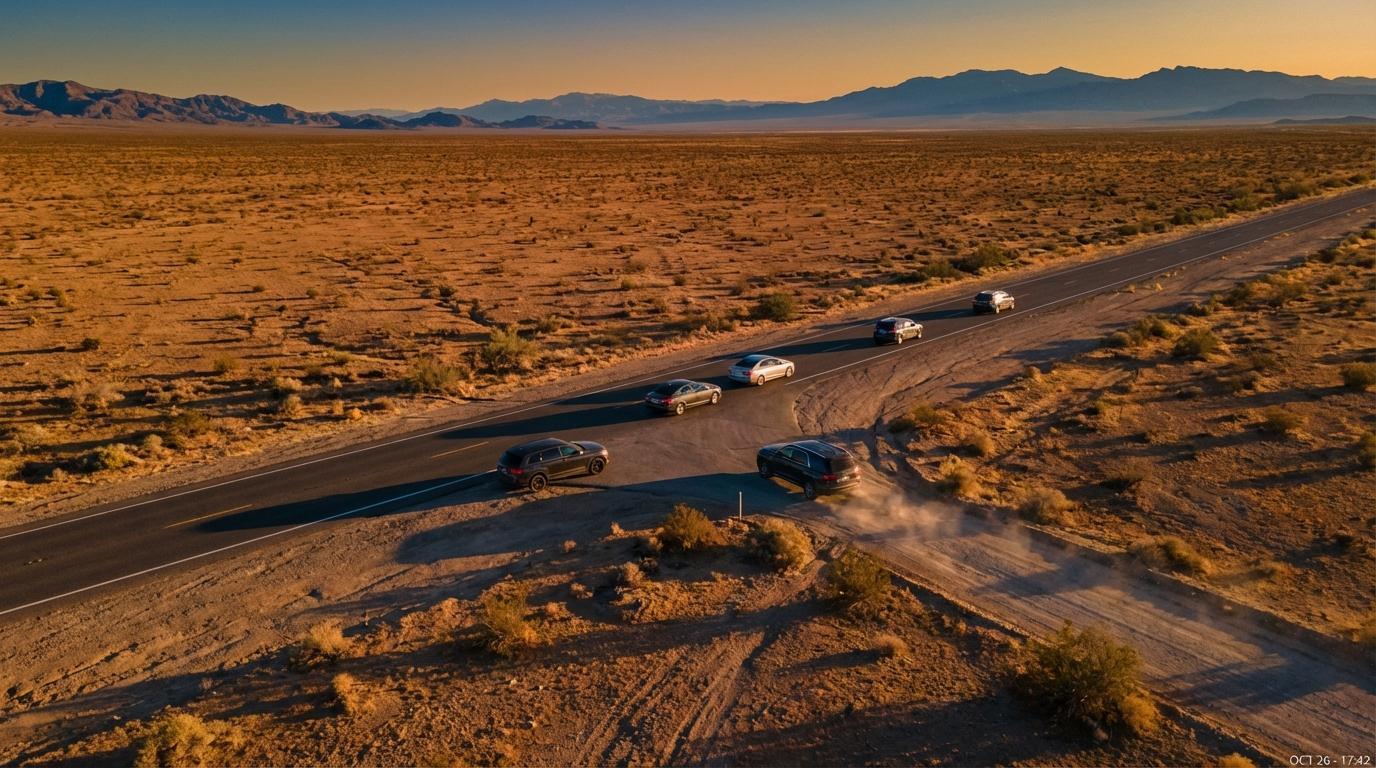
I miss turns and keep driving, even when I know I missed them. The exit went by on my right, my stomach dropped, and my hands stayed exactly where they were on the wheel. No blinker. I just looked straight ahead like a man who had always planned to stay on this highway.
I have no good explanation for it. Saying “I missed the turn” takes about a second. When you’re the lead car, though, with friends behind you following your taillights through rural Pennsylvania, and you just drove straight past the Route 30 junction, that second gets very hard to find.
And every mile makes it worse. The navigation voice starts asking for a U-turn, then asks again, and behind you somebody is watching your brake lights and starting to wonder.
How the denial goes
I’ve done this enough times to know the order. First the miss itself, a quick “wait, was that ours?” and an answer that shows up before I’ve really thought about it: the next exit is probably fine. Then I start building a case. Maybe this road connects further up, or there’s a shortcut through some town I half remember from a trip years ago.
After that I go quiet. I turn the radio up a little and fiddle with the mirrors. What I don’t do is look at the phone mount, where the blue line has given up on me and keeps politely suggesting I turn around.
Meanwhile the scenery gets less and less familiar. The road drops from four lanes to two. Somewhere past the last gas station a hand-painted sign for a bait shop goes by, and I think, very clearly, “we are not where we’re supposed to be.”
I keep driving anyway.
From the third car
My friend Marcus was in the third car during my worst one. We were heading to a lake house near Raystown, four cars, and I took the whole group past our split and onto a road that kept climbing into thicker and thicker forest. “Your car just kept going,” he told me weeks later, still laughing. “The car behind you kept going because you did. I kept going because they did.” His girlfriend had the map open in the passenger seat asking where I was taking them, and his answer was that he had no idea, but I seemed sure.
They followed me for almost twenty minutes before anyone called. By then his girlfriend was looking up a town on a road sign none of them had heard of, and the population was smaller than my high school.
What stuck with me from his version was the second car. At the junction it slowed down, and Marcus could see the driver had spotted the right turn. The brake lights flickered for half a second. Then the car sped up and came after me.
Nobody honks
You’d think someone would honk or flash their lights. Mostly they don’t. In a convoy the lead car gets treated a bit like a parent, and correcting the parent feels rude, even when every car behind can see the mistake as it happens. So everyone waits to see if the leader fixes it himself.
He almost never does.
I certainly don’t. Instead I start scanning ahead for any sign the road might loop back. In my head I draw whole road networks that don’t exist, where this random state highway somehow drops us right at the lake. Then I believe them.
Alone, a wrong turn costs you a U-turn and a few minutes. Leading a group is different, because every mile of wrong road gets driven by every car behind you, and somebody back there has a kid who needs a bathroom or a dog who is about to be sick. Turning around also stops being simple. You need a spot where four cars can do it, on a two-lane road with no shoulder, and you need everyone to know you’re doing it.
Giving up
It always ends the same way. Somebody texts a very polite “hey, are we going a different way?”, or the road runs out at a T-junction in front of a cornfield. How long I held out decides the mood for the next hour. Own it at the first exit and people laugh. Hold out until the group has to do that turnaround on a road with nowhere to pull over, and the quiet on the group call afterwards is people being polite.
My fastest recovery was a different trip, with everyone on speakerphone. “Yep, missed it.” A friend came straight back with “We know.” Nobody brought it up again for the rest of the drive.
What the shared map changed
These days we run trips with live location sharing between all your cars, and it has taken a lot of the awkwardness out of this. Everyone in the trip sees every car on one map. When I blow past an exit, my dot is right there going the wrong way, on every phone at once.
That matters more than I expected. Nobody has to be the one who calls the lead driver and tells him he’s wrong, because they can all see it, and so can I. For someone like me, who would apparently drive halfway to Ohio before saying it out loud, that is a relief. I can’t pretend the road will curve back when the whole group is looking at the same map.
One thing surprised me. Konvoyage sends the whole trip a “may be off route” alert when one car’s distance to the destination keeps going up for about a minute. But if most of the group is going the wrong way together, it stays quiet, because it assumes the group chose a new route on purpose. Which means that when I drag the whole convoy into the wrong valley, the app gives me the benefit of the doubt. Marcus thinks that is very funny. It doesn’t really matter, since the map still shows exactly where everyone is.
Finding each other again is the other part. After Raystown it took about fifteen minutes of phone calls to work out where everyone was. With the map, the cars that took the correct turn can see where you went and you can see where they are, and you pick a gas station and meet there.
The ego part
Every wrong-turn mess I’ve been in, whether I was leading or following, came from someone caring more about looking right than about getting there. At Raystown that was me, and the cars behind me paid for it.
The best leaders I’ve driven behind just say it right away, almost cheerfully. “Missed it, turning around at the next spot, sorry.” Done. They treat a wrong turn like bad weather, something that happens and you adjust for. Nobody ends up on a long detour toward Clearfield.
I’m getting better. My first instinct is still to grip the wheel and hope. But I’ve started catching myself in that stomach-drop moment while the exit is still in the mirror.
Last month it happened again on a different highway, an exit sliding past on my right and my hands already settling in for the old routine. This time I said the two words on the group call before I could talk myself out of them. “Missed it.” Marcus, third car again, said he’d already seen my dot.